
For commercial property
Grounds that look right every week
Lawn health and exterior pest control for offices, HOA common areas, churches, athletic fields, and commercial campuses across northern Indiana. One local company. One number to call.
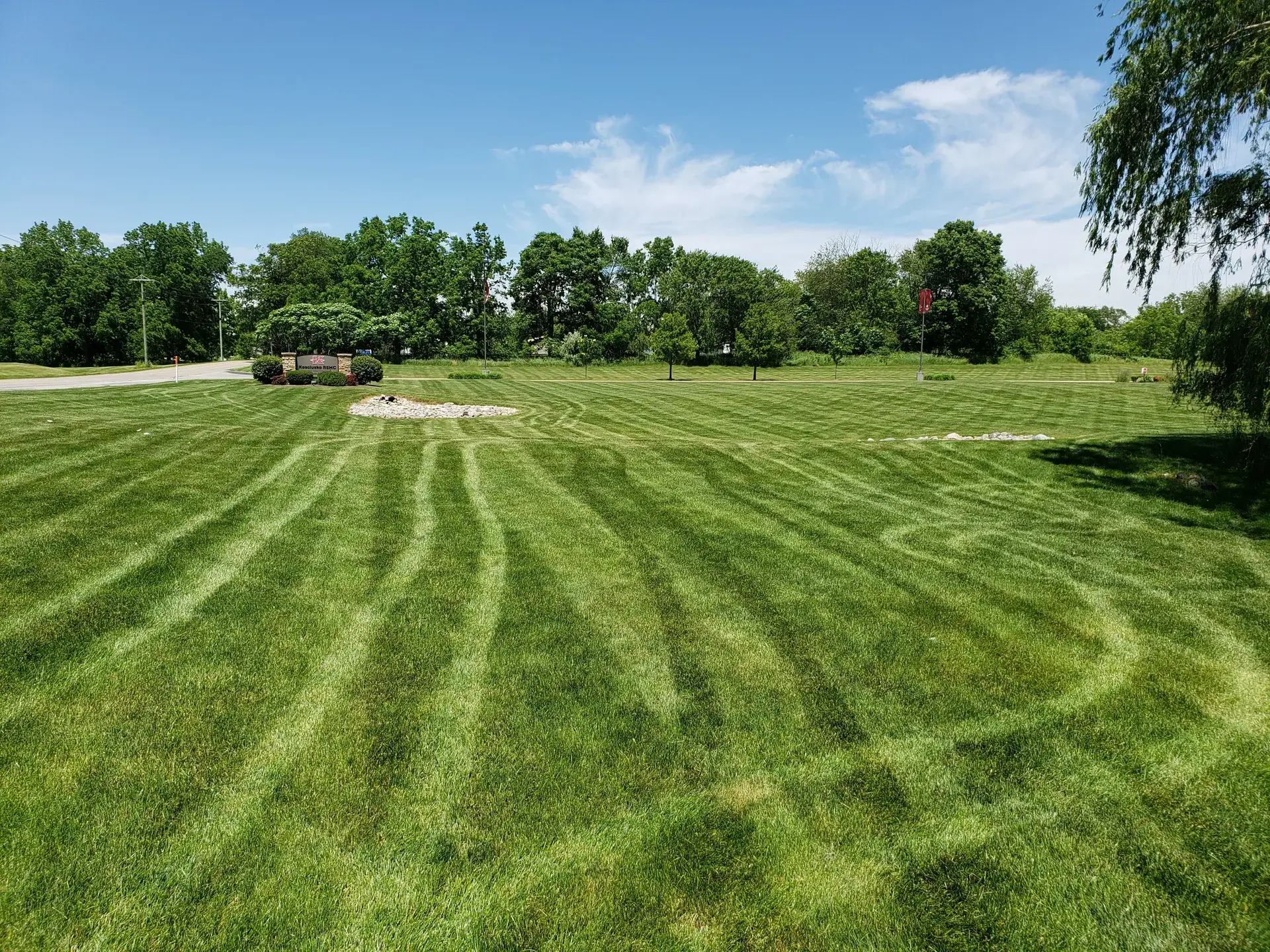
GreenWorks is owner-operated out of Pierceton with about 525 lawns under our care and more than a decade behind us. On commercial work that means fertilization, weed and insect programs, core aeration, overseeding, disease diagnosis, and perimeter or mosquito control, scheduled around your tenants, your events, and the hours your buildings are open.
What a property manager actually gets judged on
Nobody grades your grounds by walking the whole parcel. They grade it by five things, and those five are what a program has to be built around.
The entrance
It is the first fifteen feet a visitor sees, and it sets the impression before anyone reaches a door. Crabgrass in the monument bed or a brown patch by the sign gets remembered longer than anything in your monthly report.
The median
Long strips of turf between drive lanes take the worst of the summer sun and the worst of the winter salt. They show stress first, and a driver stares at them every time they wait to turn.
The strip along the parking lot
Foot traffic, drips off tires and a mower that keeps hitting the same line all show up right there. It reads as the general condition of the property even when the rest of the lawn is fine.
The complaint email
A dog walker sends a note about a weedy patch near the sidewalk. A tenant asks whether the grass got treated this month. You need an answer that is not a guess, and you need it the same day.
The board meeting
Once a month you are in front of people who own the property or run the budget, and they want to know why the grounds line cost what it cost. You need to show what got done, on what dates, and what the plan is for the next quarter.
A commercial program that ignores any of those five costs you a phone call you did not want to make.
Properties we treat
Turf a lot of people look at
A commercial property runs different than a back yard. The grounds are the first thing anyone sees when they pull in, and somebody's name is on how they look.
-
Offices and business parks
Entrances, medians, and the strip of turf everyone parks next to. The parts of a property a customer judges before they get to the door.
-
HOAs and neighborhood common areas
Entry monuments, retention areas, playground surrounds, and the shared green space a board has to answer for at every meeting.
-
Churches and cemeteries
Grounds that need to look right every weekend, treated on a schedule that stays out of the way of services, weddings, and events.
-
Athletic fields
Turf that takes cleats every week of the season. That changes what it needs from fertility and what it needs from recovery.
-
Commercial campuses
Multi-building sites, several acres of turf, and a look that has to stay consistent from one end of the property to the other.
-
Multi-family and rental property
Grounds a manager is responsible for but rarely sees. The work has to happen correctly without anyone watching it get done.
Why managers keep us
The visit happens whether you're watching or not
Most commercial grounds problems are scheduling problems. Pre-emergent went down two weeks late, so crabgrass came through the parking-lot island. Nobody caught the disease pressure in August, so a section of the field thinned out before the first game.
Somebody swapped a spring round for a summer one to save a truck roll, and the turf never got what it needed in the window that actually mattered. That is how a grounds budget gets spent without the grounds improving.
Our technicians run a route they know, on the timing the treatment actually needs, and they log what went down on which zone. You aren't chasing anyone for a status update, and you aren't finding out in October that a spring application got skipped.
The people on your property are trained, uniformed, and driving marked GreenWorks trucks. When a tenant or a board member asks who's spraying the lawn, that question has an obvious answer. And when you need to show a board or a new manager what was treated and when, that record exists rather than being rebuilt out of old email.
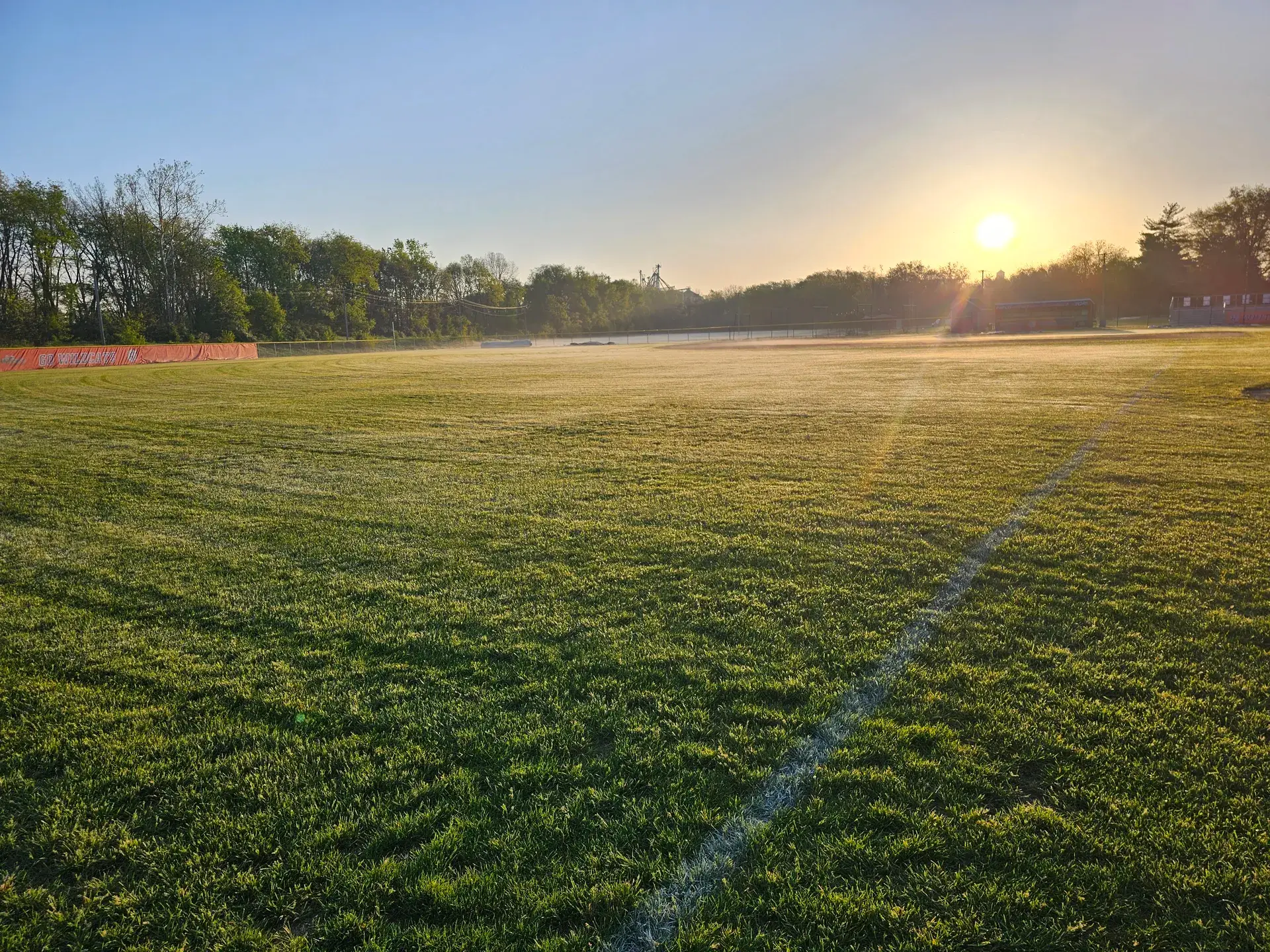
The grounds year on a commercial property
Cool-season turf up here is Kentucky bluegrass, perennial ryegrass and tall fescue. It has a good spring, a rough summer, a critical fall and a quiet winter, and a commercial program has to line up with that shape rather than fight it.
Late March to May
Late March through May is when everyone thinks the lawn looks great, and it usually does. Pre-emergent has to go down before soil temperatures hold in the mid 50s at the top couple of inches, a short window that does not wait for anyone. Spring broadleaf control in the same stretch catches the dandelions and clover a board member can see from the road.
July to August
July and August are when the wheels come off a thin program. Rain drops off, the soil warms, and cool-season turf slows down. Grub eggs have hatched by the end of July, which is why preventive grub control belongs early to mid July rather than in September once damage is showing. When somebody asks in mid July why a section looks off, the honest answer is usually that summer stress is doing what it always does, and the fall recovery is what you plan against.
September to October
September and October are the two most valuable months on the calendar. Once daytime highs leave the 90s, September is the highest-return feeding of the year. Local rainfall drops from about 4.88 inches in June to about 2.91 inches in September, roughly a 40 percent decline, exactly when a property coming out of summer needs the most help. Core aeration and overseeding both belong in this window on nearly any commercial property carrying wear.
November
November is the other feeding that pays back out of proportion to the effort. A late application near or after the last mow, while the lawn is still green, feeds the roots through winter and buys an earlier, denser green-up in spring.
Spring-only programs show it by August. That is why the fall window matters more than most boards realize, and why a mid-season conversation about switching is really a conversation about what September and November get to do this year.
What drives the price on a commercial property
Every commercial quote comes off a site walk. Two properties with the same acreage on the tax roll can price out very differently, so it is worth knowing which factors move the number.
- Treated acreage, not parcel size
-
A ten-acre parcel with three acres of turf and seven acres of woods, retention or paving prices against the three acres.
- Turf versus ornamental beds
-
Bed edges, mulch rings and ornamental plantings are handled differently from open turf, so two properties at the same total acreage quote differently.
- Whether the property is irrigated
-
Irrigated turf holds up through July and August but runs into disease pressure that dry turf does not, which adds fungicide considerations and a monitoring cadence.
- Restricted access windows
-
If we can only treat before 7 a.m. on a Monday, or only when a field is off the practice schedule, that changes route planning and it changes the quote.
- How many applications the program carries
-
A lighter program and a fuller one are not the same product, and the difference shows up in how the turf performs in July and again in October.
- Athletic field wear and recovery
-
Turf that takes cleats every week needs a fertility program built around recovery rather than color, and aeration and overseeding rates on a field are not the rates for an office lawn.
- Multi-site consistency
-
Running one program across several properties for the same manager is different work than a single site, and it changes how we schedule the season. That usually works in your favor.
Send the address and rough acreage through the quote form and we will come walk it.
Scheduling around tenants, events, and your hours
A commercial route is a scheduling problem before it is a treatment problem. What the turf needs is usually clear. When we can be on the property to give it is the part that has to be worked out.
Churches
Churches need the grounds clear by Saturday afternoon. A treatment that has to sit before foot traffic cannot go down Saturday morning, and it cannot be running while the lot fills for a wedding. Most church work lands Monday through Thursday, built around the events board rather than the other way around.
Athletic fields
Athletic fields work around practice and game days. A field booked Tuesday, Thursday and Saturday gets treated on the off days, and anything needing time to dry in gets planned into the longest gap of the week. The heavier work, aeration, overseeding and repair, moves to the post-season.
Offices and business parks
Offices and business parks get treated before open where the schedule allows. Nobody wants the crew on the front lawn while the first meeting of the day is walking in.
HOA and multi-family
HOA common areas and multi-family properties run through whatever resident communication you already have, whether that is a note at the mailbox cluster or an email through your management platform. The notice, the timing and the language stay yours. We give you the dates so you can send it.
To plan a year we need your closed dates, the events that cannot be interrupted, access hours for each site, and any resident communication rules already in place. With that in hand we build a route that treats every property on time without colliding with your calendar.
Who's responsible for what
Every commercial property has several vendors touching the grounds, and one of the most common first questions is where our work stops and everyone else's picks up.
Your mowing crew mows, edges and blows off the hard surfaces, keeping the lawn at height week to week. GreenWorks does not mow.
Your irrigation contractor handles the system itself: heads, valves, controllers, spring startup, fall blowout and any repair to pipe or wiring. We will flag a zone running dry or spraying the sidewalk, but we are not the ones adjusting the clock.
Your landscape crew handles bed installation, tree and shrub work, mulch and seasonal color. GreenWorks does not landscape. If you are pricing a whole grounds contract to one vendor, that is not us, and we will say so up front.
We handle the lawn itself. Fertilization and weed control, pre-emergent, broadleaf work, grub prevention, core aeration, overseeding, mechanical dethatching, and disease diagnosis with fungicide programs, plus mosquito, flea and tick, and perimeter pest control around the buildings.
Switching mid-season
Most commercial accounts do not switch in January. They switch when something visible goes wrong and the current vendor cannot answer for it, which usually means late spring or mid summer.
What can be picked up is the fall calendar, in full. The September and November feedings, aeration and overseeding, grub prevention where a property needs it, and pre-emergent for the following spring. On a property we get onto by mid summer, the fall work carries the load and sets up a real spring.
The first few weeks look like a site walk, a soil read where it is warranted, and a written program with dates. If there is active disease or an insect problem in front of us, we treat it.
What does not recover until fall is a lawn that got no pre-emergent and now carries mature crabgrass. Options in July are limited and inconsistent, and the real answer is a strong pre-emergent next spring plus a fall overseed to thicken the stand. A thin stand takes three to four full seasons to become turf that outcompetes weeds on its own.
Commercial service pages
The specifics of what goes into each program live on the individual service pages.
Lawn care
Pest control
Questions
What property managers ask before switching
Do you do mowing or landscaping on commercial property?
No. We handle lawn health and exterior pest control. Fertilization, weeds, insects, aeration, overseeding, disease. Your mowing and landscape crews keep doing their work, and we schedule around them.
How big of a property can you take on?
Anywhere from a single office frontage to multi-acre campuses and athletic fields. Size changes the equipment and the schedule. We can service it either way. Call us with the acreage and we'll confirm.
Who do I call when something looks wrong out there?
You call (574) 549-3650 and get the same office every time. One point of contact, no account-manager layer between you and the people running the work on your property.
Can you work around events and business hours?
Yes. Tell us the dates and windows you need the grounds clear. Churches, schools, and offices all have hours that treatments have to steer around, and that's a normal part of planning the year with a commercial account.
Where do you handle commercial work?
Across Kosciusko, Whitley, southwest Allen and Huntington counties, Indiana. That covers Warsaw, Winona Lake, Pierceton, Leesburg, Syracuse, and North Webster on the lake side, Columbia City, Larwill, and South Whitley in Whitley County, plus Milford, Roanoke, and the Aboite area of southwest Fort Wayne.
Do you handle multi-site accounts under one point of contact?
Yes. Running the same program across several properties for one manager is a normal shape of account here, and it usually simplifies both the scheduling and the paperwork.
Can you give us a record of what was treated and when?
Yes. Ask and we'll put together the dates, the areas treated and the work performed, so you can hand it to a board, an auditor or a new manager without reconstructing the year out of old email.
What moves the price on a commercial property?
Treated acreage rather than parcel size, turf versus ornamental beds, whether the property is irrigated, how restricted the access windows are, how many applications the program carries, and whether athletic field wear is in play. We quote after a site walk, because two properties at the same acreage can price out very differently.
Get a quote for your property
Send us the address and the rough acreage. We'll walk the site, tell you what the turf needs, and put a program and a price in front of you.