
Kosciusko County, Indiana
Lawn care and pest control in North Webster
North Webster sits on the droughtiest ground on our route. Almost two thirds of the town is one loamy sand that holds about 0.09 inches of water per inch of soil. And about one in five houses here is seasonal, meaning the lawn spends long stretches with no one watching it.
Sand, and not much else
Most of the towns we work in have three or four soils inside their limits and the program changes with the ground. North Webster is not one of them. Roughly 63 percent of the town, in a single map unit, is Boyer loamy sand: about 84 percent sand, well drained, hydrologic group A, holding around 0.09 inches of water per inch of soil and passing water at about 92 micrometres per second.
That is the bottom of the range we see anywhere. For comparison, Larwill, over the county line in Whitley, sits on Morley clay loam that moves water roughly 33 times slower. Same summer, same weather, completely different lawns.
What that means for the work is straightforward. Water and any nutrient dissolved in it leaves fast, and it leaves everywhere. A single heavy spring application is largely gone before the roots have a chance at it. Lighter, more frequent rounds keep nitrogen in front of the grass when it can actually take it up, and irrigation matters more here than most homeowners expect. Regionally, June averages around 4.88 inches of rain and September drops to about 2.91, roughly a 40 percent falloff, landing right when cool-season turf is trying to recover and when fall seeding needs moisture to establish. On sand, that drop is the difference between a lawn that fills back in thick in October and one that limps into winter thin.
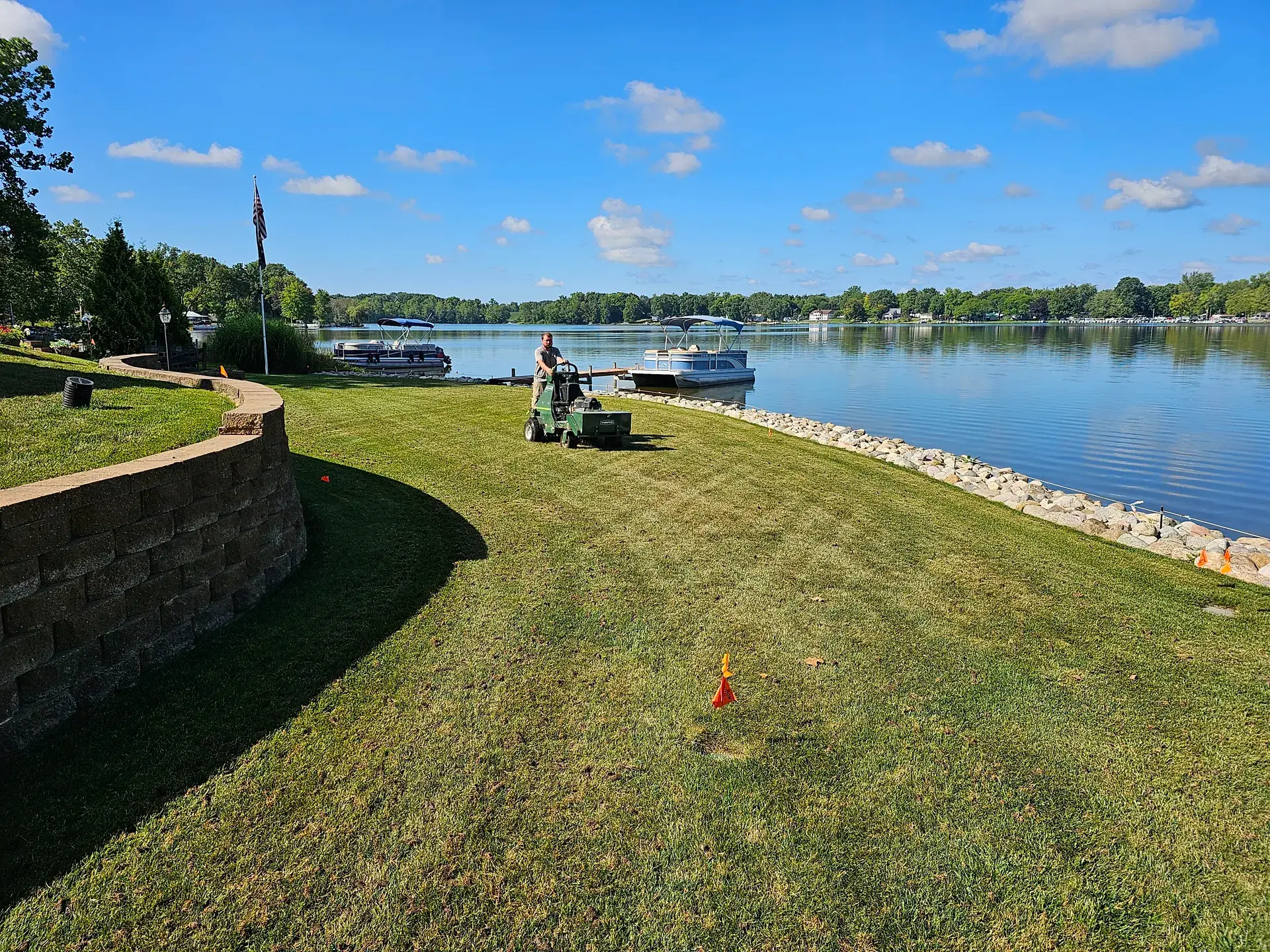
There is one other soil worth naming. About 9 percent of the town maps as Aquents-Urban land, the mapping convention for filled, disturbed, built-over ground. That is the shoreline strip where the lakefront lots actually sit, and it does not behave like the Boyer next door. It holds water where it was filled in, and the built-up sections around seawalls, patios and cut-and-fill lots have their own drainage story. We treat those lots the way the soil under them actually reads, not the way the town map averages.
The Boyer sand and the Aquents strip are the two lawns of North Webster. Both want a customized program, and neither does well forgotten for three weeks.
- County
- Kosciusko County
- ZIP codes
- 46555
- From the shop
- A run north of the shop, out to the Webster Lake shore.
- Ground
- One soil, nearly two thirds of the town. Loamy sand that holds about as little water as ground can hold, with a strip of fill along the shoreline that behaves nothing like it.
- Drainage
- Faster than anywhere else we work. Water and feed both leave quickly, and they leave everywhere, not just in patches.
- Housing
- Median home built around 1977, so not an old-foundation town. About one house in five is seasonal or recreational, empty much of the year.
What North Webster properties need
What Webster Lake properties need
Thirsty sand up the road and filled shoreline ground at the water. These are the treatments that come up most on both.
-
Fertilization & Weed Control
Boyer sand leaches a heavy spring feeding fast. Split, lighter rounds put nutrients in front of the roots at the right time and cut what runs past them. Pre-emergent goes down timed to soil temperature rather than the calendar, because on this sand the warm curb strips are the first place crabgrass gets started.
See how it works -
Core Aeration
Sand collapses under foot traffic and around driveways, patios and pool decks, and the Aquents strip along the shoreline can pack tight where it was filled. Cores loosen the profile so water gets down to the roots instead of running off. On the Aquents lots, aeration is also how compacted fill starts breathing again.
See how it works -
Overseeding
Cool-season grass roots faster in cooling soil, so fall seed dropped into open aeration holes on Boyer sand is the fastest way to fill thin ground back in. September rain lines up right for it, but a new seeding on this sand still needs water put on it.
See how it works -
Grub Control
On Boyer sand you can peel a chewed-up lawn back like carpet before you notice. A preventative application in early summer stops that. Repairing the damage in September, on ground that already dries out fast, costs a lot more.
See how it works -
Mosquito Control
Webster Lake is a short walk from most of the town, and the lawns that back up to it, or to a low spot, always have somewhere for mosquitoes to breed. We treat the shaded harborage on your own property, along the fence, under the deck, at the shrub line, where they rest during the day.
See how it works -
Perimeter Pest Control
The median home in North Webster was built in 1977, so this is not the old-foundation story you get in Pierceton or Larwill. It is a lake-town story: docks, boathouses, breezeways and screened porches give ants, spiders and boxelder bugs a lot of ways to cross from the outside in. A treated band outside cuts that traffic without pretending to seal the building.
See how it works
The lawn that sits empty half the year
About one in five housing units in North Webster is seasonal, recreational or occasional-use. Roughly two thirds of everything the census counts as vacant here is a lake house between visits. On any given weekday a large share of the town's lawns have nobody standing at the window.
Put that on top of the soil and it stops being a curiosity. Boyer sand does not coast for three weeks. It goes backwards fast and visibly.
What we can tell you is what the ground does while nobody is watching it. Weeds get their start along the warm strips first. Grubs feed straight through August. Crabgrass sets seed in a window that will not wait for you to be in town. Fall seeding lines up with a rain pattern that peaks weeks before the leaves turn. All of those decisions are timed to soil and weather, not to when the owner is around, which is the practical argument for a program rather than a phone call in July.
The lakefront strip is the other half of the picture. The Aquents-Urban land units along the water were filled and built on, and they compact differently than the Boyer sand up the road. Lawns on that strip usually need more aeration and more patience with fertilization, because the ground itself is not one profile, it is whatever the site was made out of.
North Webster lawn questions we get
Why does my North Webster lawn brown out faster than my neighbor's over in Warsaw?
Because your soil is thirstier. Warsaw is loamy sand at about 0.11 inches of water per inch of soil, and even that is droughty by most measures. Roughly two thirds of North Webster sits on Boyer loamy sand at 0.09. Water is leaving your ground faster, so the same July week hits you harder.
Our place is seasonal. Can you treat it if we're not there?
Yes. Access to the yard is what we need, not the owner on site. Applications are timed to soil and weather, so the lawn gets treated on the schedule it actually asks for rather than the schedule you happen to be in town on.
Do you use phosphorus on lawns near Webster Lake?
Not by default. Indiana restricts phosphorus on established lawns, and we run phosphorus-free unless a soil test says the ground is actually short. That is the safer answer for a lake town and the honest answer for most Boyer sand lawns, which are rarely short on phosphorus in the first place.
My yard sits on filled ground near the seawall. Does it need something different?
Probably. The shoreline strip maps as Aquents-Urban land, which is the mapping term for disturbed and filled ground. It doesn't behave like the sand up the block. Compaction and drainage change from lot to lot on that strip, so we walk it before we quote.
What about the town's grass or watering rules?
We could not confirm a specific town rule on grass height or watering when this page was written, and we would rather point you at the town than misquote it. Town Hall can give you the current rule in a two-minute call.
Do you mow?
No. We do lawn health and exterior pest control: fertilization, weed and grub work, aeration, overseeding, perimeter and mosquito treatments. We do not mow or landscape, but we will point you to a company we trust if you ask.
Nearby
Nearby towns we also treat
Syracuse, Warsaw and Winona Lake are all on the same run, and most weeks we are in one of them.
Get a price on your North Webster lawn
Send the address and tell us how you use the place, full time or seasonal. We'll walk the lawn, read the soil, and put a program and a price in front of you.