
Kosciusko County, Indiana
Lawn care and pest control in Leesburg
We treat lawns across Leesburg out of our Pierceton shop. On this ground the job is protecting the four inches of good topsoil sitting over sand and gravel, so the program stays light, patient, and built to keep water and feed inside the root zone rather than running it through into the aquifer below.
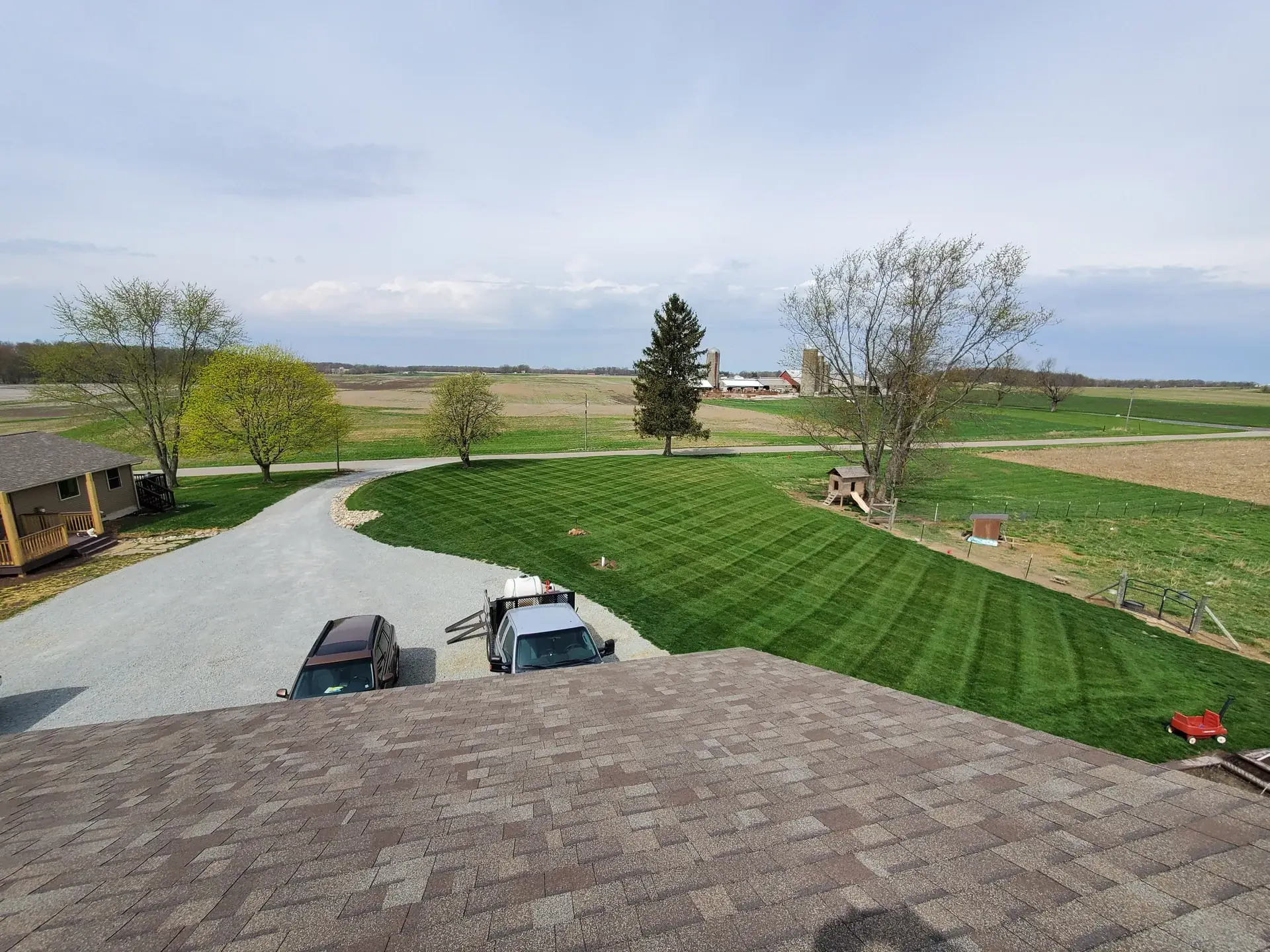
Four inches of good dirt over gravel
Fifty-five percent of Leesburg maps to two well-drained outwash soils, Shipshe and Carmi, and a further six percent is literally active gravel pits. That is not a metaphor. The soil survey has a map unit for pits, and it shows up inside the town. The story of the ground here starts and ends with what is under those first few inches.
The topsoil itself is genuinely good. Both Shipshe and Carmi carry about three percent organic matter in the top foot, the best surface reading on our route, with available water capacity around 0.17 inches of water per inch of soil. Grass grown in that layer has plenty to work with. Roots find nitrogen, they find moisture, and a lawn that gets fed sensibly looks it.
Then the profile falls off a cliff. At roughly three to four feet down, water capacity collapses to about 0.03 as the loam gives way to sand and gravel, and water starts moving through fast. Anything that gets past the root zone is gone, and it is going into the same outwash the town's own water system draws on.
That inverts the Pierceton program almost entirely. Pierceton sits on heavier moraine till that shuts water out at the surface, so opening the ground up is the first move there. Leesburg's surface takes water fine. The problem here is what happens after. A heavy spring feeding on this ground puts nitrogen through the root zone in one storm and toward the aquifer in the next.
So the whole approach here is about protecting the four inches that work. Lighter, more frequent feeding. Overseeding to thicken the canopy so more of what falls stays where roots can use it. Aeration used to deepen the root zone one pass at a time, not to break through it. Water in a couple of tight sessions rather than a daily quarter-inch that never reaches down. The tank is shallow, and everything else follows from that.
- County
- Kosciusko County
- ZIP codes
- 46538
- From the shop
- Northwest of the shop, out past Warsaw.
- Ground
- Outwash gravel with a genuinely good few inches on top. More than half the town is two well-drained outwash soils, and about six percent of it is working gravel pit.
- Drainage
- Drains fast and keeps going. The topsoil holds water fine, then the tank runs out at three to four feet where it hits sand and gravel.
- Housing
- Nearly forty-five percent of the housing predates 1939 and effectively nothing has been built since 2010. Old foundations, settled sills.
What Leesburg properties need
What Leesburg lawns need most
Good topsoil over a shallow tank. Almost everything here is about keeping water and feed inside the layer that works.
-
Fertilization & Weed Control
The topsoil here holds water and nutrients fine, but everything below is sand and gravel. A heavy spring feeding puts nitrogen through the root zone before the grass can use it, and toward the same outwash the town's own water system draws on. Lighter, more frequent rounds keep the feed in front of the roots. Phosphorus-free by default.
See how it works -
Overseeding
A thicker canopy is one of the best defenses this ground has. Denser turf slows what runs off, holds more of what falls, and shades the topsoil against summer drying. Fresh seed goes down into open aeration cores in fall, when the September soil roots faster than any spring seeding ever will.
See how it works -
Core Aeration
Aeration on this ground is not about breaking through it, it is about deepening the productive layer one pass at a time. Cores let water, air and feed reach further down each fall, so the root system can push into more of the topsoil rather than crowding the top inch.
See how it works -
Grub Control
Well-drained sandy loams like Shipshe are exactly the ground white grubs prefer, and on soil that dries this fast, a chewed root system is the end of the summer for a lawn. A preventative application in early summer stops them cheap. Repair in September, on ground that drains this fast, costs a lot more.
See how it works -
Mechanical Dethatching
When the mat at the soil line gets thick enough that water beads instead of soaking in, seed and feed stop reaching the topsoil. On ground where the topsoil is your whole working budget, that mat costs more than it does anywhere else. A dethatcher pulls it up so the good four inches are back in play.
See how it works -
Perimeter Pest Control
Nearly half of Leesburg's houses were built in 1939 or earlier, and more than eight in ten are owner-occupied. Old foundations that have settled give ants, spiders and boxelder bugs a lot of ways in at the sill and the vents. A treated band outside cuts that traffic without pretending to seal an old building.
See how it works
The oldest town in the county
Leesburg was laid out in 1833. That is two years before the county that contains it was authorized, and three years before the county was organized. For eighteen years starting in 1836, Leesburg was the county seat. It lost the seat to Warsaw in November 1854 when the railroad reached Warsaw and did not reach here, and the town has been the quiet one on this stretch of road ever since. The historic district was added to the National Register in 1993.
The housing stock tells the same story. About 44.6 percent of the homes in town were built in 1939 or earlier, one of the highest pre-1939 shares anywhere on our route, and 84.3 percent of those homes are owner-occupied, a higher share than the county as a whole. Effectively nothing has been built here since 2010. A town of about five hundred and fifty people, sitting on foundations that have been in the ground for a hundred years or more, owned by the people living in them.
Two things follow. First, the perimeter work has real value here. Foundations that old have settled, sills have moved, and every masonry-to-siding seam is a way in for ants, spiders and boxelder bugs. A treated band outside cuts that traffic, and the homeowners paying for it are usually the same people who watched the ants come in last May and know exactly which corner they used.
Leesburg lawn questions we get
What is Leesburg's grass or yard-waste ordinance?
Leesburg's ordinance code is not published online in a way we can read, so we stay out of quoting a rule we haven't confirmed. If you have gotten a notice, the town clerk's office on Van Buren Street is the place to ask. Trash pickup is Thursdays, per the town's own site.
Why does my Leesburg lawn dry out even when I water it a lot?
The topsoil is shallow here. About three to four feet down, the ground turns to sand and gravel, and water capacity collapses. A daily light watering barely reaches the working layer, and anything that gets past it is gone into the outwash below. Two or three deeper, spaced-out sessions a week keep more of the water where roots can use it.
Do you use phosphorus on lawns in Leesburg?
Not by default. The ground under Leesburg drops off into sand and gravel a few feet down, over the same outwash the town's own water system draws on. Indiana restricts phosphorus on established lawns, and we run phosphorus-free unless a soil test says the ground is actually short.
My house was built in the 1920s. Does perimeter pest control help?
Yes, and on a foundation that age it is one of the more useful things you can do. A treated band outside cuts the ants, spiders and boxelder bugs crossing at the sill and around vents. It will not seal every gap, but paired with basic work at hose bibs and the garage door it does more than either one alone.
When should crabgrass pre-emergent go down?
Timed to soil temperature, not the calendar. The date shifts every year with the weather. Leesburg's sandy outwash tends to warm a little earlier than the heavier moraine ground east toward Pierceton, so the treatment usually goes down a few days sooner here.
Do you mow lawns in Leesburg?
No. GreenWorks is a lawn-health and exterior pest-control company. We feed the soil, control weeds and insects, aerate and overseed, and treat the outside of the house. Someone else cuts the grass. If you need that someone, ask and we'll point you to a company we trust.
Nearby
Nearby towns we also treat
Warsaw, Milford and Syracuse are all on the northern end of the route, and most weeks we are in one of them.
Ask us about your Leesburg lawn
Send the address and what's bothering you about the yard. We'll walk the property, tell you what your topsoil has to work with, and put a program in front of you that keeps feed and water where the roots can reach it.