
Kosciusko County, Indiana
Lawn care and pest control in Syracuse
Syracuse is the town where the honest answer changes by address. Inside one small municipality you'll find outwash sand that drains almost too fast, a heavier loam that holds water and compacts, and belts of muck and poorly drained ground near the lakes. The program has to fit the ground.
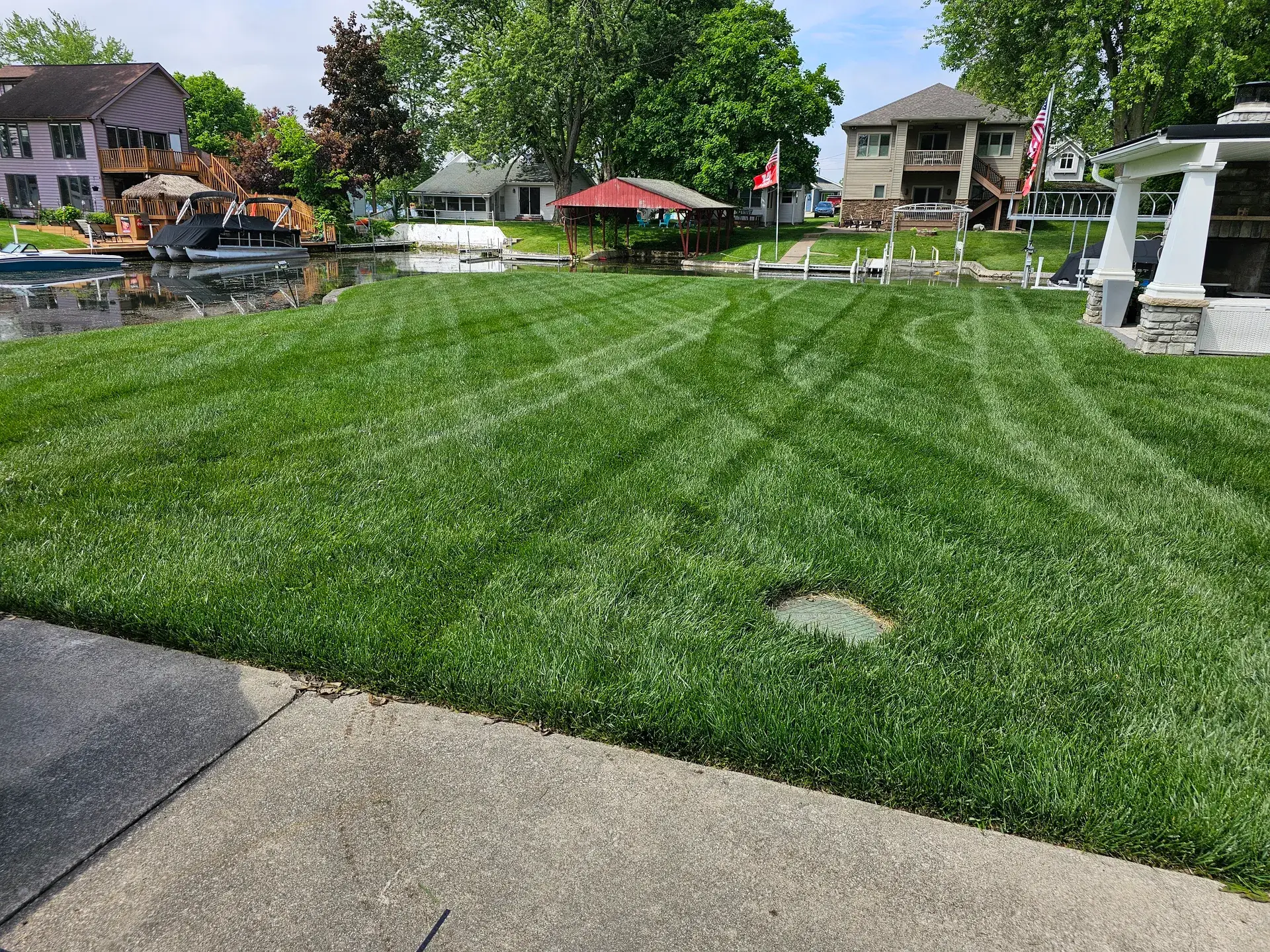
In Syracuse the answer changes by address
Most towns on our route sit on one dominant soil with a few pockets of something else. Syracuse doesn't. The soil survey inside the town limits shows a genuine mosaic, and it is small enough that two houses on the same street can need opposite programs.
On the sandy side of the mosaic you get Ormas loamy sand, roughly four fifths sand, holding about 0.11 inches of water per inch of soil. That is Warsaw-grade outwash. Water and any nutrient dissolved in it moves through fast, so one heavy spring feeding is largely gone before the grass has used it. Kosciusko sandy loam, the single largest map unit in town, is a bit better at 0.17 but still leans sandy.
Then there is Miami loam at about 15 percent clay, in hydrologic group C. It behaves like neither a sand nor a muck. It sets up firm after a dry stretch, shuts water out at the surface, and asks for core aeration more than another round of nitrogen.
And then the wet side. Add up Homer sandy loam, Sebewa loam, Gravelton and the Histosols and Aquolls near the water, and about 23 percent of the ground inside Syracuse is somewhat poorly drained or worse. Some of it is organic muck. Some of it is mapped as occasionally flooded. On that ground the problem is never water, it's air, and cores plus patient feeding do more than any single application ever will.
About 13 percent of the area inside the town boundary maps as open water, because Syracuse Lake is inside the town line. That means a real share of the lawns in Syracuse either front the lake or drain toward it, and the program has to account for that too.
We walk the property before we quote it. The point of a walk in Syracuse is figuring out which of those soils you actually have, so the program fits your lot instead of the town average.
- County
- Kosciusko County
- ZIP codes
- 46567
- From the shop
- North of the shop, up to the top of the county.
- Ground
- Four soils in one small town. Outwash sand on one street, a heavier loam with real clay in it on the next, and muck down by the water.
- Drainage
- Changes by address. About a quarter of the ground inside town is somewhat poorly drained or worse, and the sand beside it drains too fast.
- Housing
- Median home built around 1957, roughly three in ten predating 1939, and about one home in ten is a lake place used only part of the year.
What Syracuse properties need
What Syracuse properties call us for
Sand, loam, muck and lakefront, all inside one town. These are the treatments that come up most, and which ones your lot needs depends on where it sits.
-
Fertilization & Weed Control
The Wawasee Area Conservancy Foundation, headquartered here in town, puts it plainly for lakefront lawns: multiple low-level applications are preferable to a single large dose. That is also what the sandy soils in Syracuse need on their own terms. Lighter rounds across the season keep nitrogen in front of the roots instead of leaching past them, and pre-emergent goes down timed to soil temperature rather than the calendar.
See how it works -
Core Aeration
The Miami loam under a lot of Syracuse yards sets up firm and shuts water out at the surface, and the wet units on the low side of the mosaic stay saturated because roots can't reach air. Pulling cores fixes both problems from the same pass. On a lawn that has been fed for years without improving, this is usually the missing piece.
See how it works -
Grub Control
On the Ormas sand side of town, grubs can peel a stressed lawn back like carpet before you notice. A preventative application in early summer stops that, and it is cheap relative to repairing chewed-up turf in September on ground that already dries out fast.
See how it works -
Disease & Fungicide Programs
The muck pockets and the humid air off Wawasee keep the canopy wet longer than most Kosciusko lawns. That is where dollar spot, brown patch and leaf spot start. Reading the lawn early in the season tells us whether a preventative round is worth the money on your yard or whether we can hold off.
See how it works -
Mosquito Control
With 13 percent of the town's area under water and roughly a quarter of the ground somewhat poorly drained, there is always somewhere for mosquitoes to breed in Syracuse. We treat the shaded harborage on your own property, the shrub line, under the deck, along a fence, where they actually rest during the day.
See how it works -
Perimeter Pest Control
Syracuse's median home was built in 1957 and about 30 percent of the housing stock predates 1939. Ants, spiders and boxelder bugs cross at the foundation seam of an older house, not through the middle of the yard, and a treated band outside cuts that traffic hard.
See how it works
Lawns on Wawasee and Syracuse Lake
The Wawasee Area Conservancy Foundation is based in Syracuse and publishes lawn guidance for lakefront homeowners. It lines up almost exactly with what the soil under most of these properties argues for on its own. Their recommendations, condensed: leave at least a ten-foot unfertilized strip along the shoreline, avoid phosphorus or potash unless a soil test says you're actually short, feed in the fall when roots can store nutrients, and, in their words, prefer multiple low-level applications to a single large dose.
That guidance is exactly that. The reasoning still holds. When a lakefront property runs a program that respects it, less of what goes on the lawn ends up in the lake, and the lawn itself does better because the applications are sized to what the grass can take up in one round.
Indiana restricts phosphorus on established lawns, and we run phosphorus-free unless a soil test says otherwise. Granular product gets swept off drives and walks before we leave, because anything that lands on a hard surface is one storm away from a storm drain.
The lakes themselves are, comparatively, in decent shape. The Lilly Center for Lakes and Streams at Grace College samples county lakes every summer, and Wawasee and Syracuse Lake do not show up on the list of the most nutrient-rich water in the county. That is worth protecting rather than repairing, and it is the reason a homeowner asking whether their fertilizer choices matter is asking the right question.
Syracuse lawn questions we get
My front yard dries out fast and my back is soggy. Why?
Because Syracuse is a mosaic. Your front and back may sit on two different soil units. It is common to have Ormas sand under one part of a lot and a poorly drained unit under another, and they need different watering and different feeding. When we walk the property, sorting out which soil is where is most of what we do.
How does the town's summer sprinkling rate work?
Syracuse's sewer code has a sprinkling rate that lets single-family residential customers have their June through September sewer bill calculated from their December through March water use instead of the actual summer read. The homeowner has to notify the Clerk-Treasurer on or before the first of the month it applies to. Terms change, so confirm the current version with the town.
Our house sits empty in the winter. Does the town account for that?
Yes. The same sewer section provides that residences not occupied from December through March are billed on the average of the previous thirteen months the residence was occupied, for the purpose of the sprinkling rate adjustment. Confirm the current process with the Clerk-Treasurer.
Can I drill a well just for lawn irrigation?
Syracuse's code allows a non-potable well drilled for lawn irrigation only, subject to state well-construction standards and an approved check valve. It is one of the few towns on our route that spells that out. Talk to the town and to a licensed driller before you commit.
Do you use phosphorus on lakefront lawns?
Not by default. Indiana restricts phosphorus on established lawns, and we run phosphorus-free unless a soil test says the ground is actually short. On a Wawasee or Syracuse Lake property that also lines up with what the Wawasee Area Conservancy Foundation recommends for lakefront yards.
Do you mow?
No. We do lawn health and exterior pest control: feeding, weed and grub work, aeration, seeding, perimeter and mosquito treatments. We do not mow or landscape, but we will point you to a company we trust if you ask.
Reviews
What Syracuse neighbors say
“Our yard was a disaster - patchy and weedy. Alex worked very hard on the repairs and I am very happy with the results. He was easy to communicate with and went the beyond expectations. Highly recommend!”
“They have been doing our yard and a few of our neighbors for a couple years now. Our lawn looks amazing, and all we do is mow it!”
Nearby
Nearby towns we also treat
North Webster, Milford and Leesburg are all on the northern end of the route, and most weeks we are in one of them.
Get a price on your Syracuse lawn
Send the address and what's bothering you about the yard. We'll walk it, tell you which of Syracuse's soils you actually have, and put a program and a price in front of you.