
Whitley County, Indiana
Lawn care and pest control in Larwill
Larwill has no public water supply, so every lawn in town is watered off a private well. It also sits on the heaviest ground we work, clay-rich Whitley County till where roughly half the town is somewhat poorly to very poorly drained. Both facts change the program.
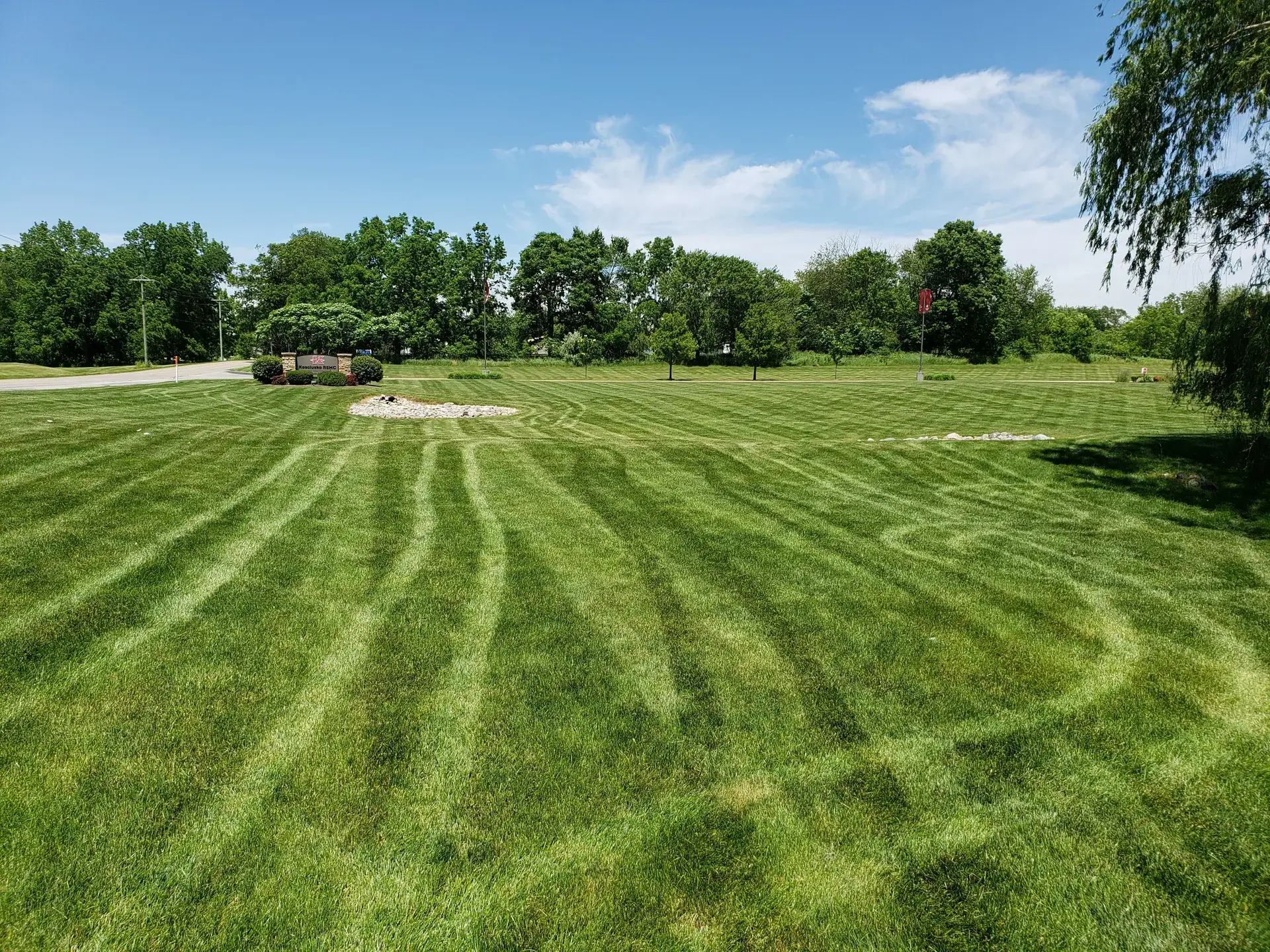
The heaviest ground we work
Cross into Whitley County and the landscape changes. Larwill isn't a lake town and the soil under it isn't a Kosciusko soil at all. It sits on the interlobate moraine, clay-rich till that behaves nothing like the outwash sand a few miles west, and it is heavier than Pierceton.
Inside the town limits the three largest map units are Morley loam on rolling slopes, Pewamo silty clay loam and Blount loam. Pewamo runs about 35 percent clay and is mapped as very poorly drained. Blount is hydrologic group D, the worst drainage class the grouping has. Add Haskins and Coesse and roughly half the town is somewhat poorly to very poorly drained. The Morley phases at higher clay content move water at about 2.82 micrometres per second. For scale, that is roughly 33 times slower than the Boyer sand that covers most of North Webster up in the lake country.
Available water capacity in these soils runs about 0.16 to 0.21 inches per inch of soil, roughly double what North Webster is working with. That sounds like an advantage. On clay till in hydrologic group C and D, on slopes mostly mapped as eroded or severely eroded, it is the opposite. Water sits, air does not get in, and after a dry stretch the surface sets up like a driveway. Roots stay shallow because they can't push down through it.
The prescription is close to the inverse of the lake-town program. The problem isn't getting water in, it's getting air in. Core aeration is the single highest-value thing most Larwill lawns can get, and on the worst ground it earns a second pass. Heavy watering is actively counterproductive on a Pewamo or a Blount that already holds 0.21 inches per inch, and one deep pass of cores does more for a compacted lawn than another round of nitrogen ever will.
We treat this ground on its own terms. Nothing that works on a sandy Kosciusko lot gets carried across the county line unchanged.
- County
- Whitley County
- ZIP codes
- 46764
- From the shop
- East of the shop, over the Whitley County line.
- Ground
- The heaviest ground we work. Clay till, with a silty clay loam in the flats that runs about a third clay and is rated very poorly drained.
- Drainage
- Slow, and then slower. Roughly half the town is somewhat poorly drained or worse, and the clay moves water tens of times slower than lake-town sand.
- Housing
- Median home built around 1945, nearly half of it predating 1939, and essentially nothing built since 2009.
What Larwill properties need
What Larwill properties need most
Village lots and county-road acreage on the heaviest ground we work. Almost everything here starts with getting air into the soil.
-
Core Aeration
Clay-rich Blount and Pewamo shut water and air out at the surface. Pulling cores is the one treatment that opens the top few inches so roots can breathe, and it is the highest-value work most Larwill lawns can get. On the worst ground it earns a second pass in the fall.
See how it works -
Mechanical Dethatching
When water beads on the surface and the lawn feels spongy, there is a mat at the soil line that the aerator will not fully take out. A dethatcher pulls that mat up so seed, feed and rain can reach the ground again. On clay till, that mat forms faster than it does on lighter soils.
See how it works -
Fertilization & Weed Control
Feeding built for heavy ground looks different than feeding on sand. Nitrogen stays around longer, so the program leans on fewer, better-timed rounds rather than the split rounds a sandy lawn wants. Pre-emergent goes down timed to soil temperature rather than the calendar. Indiana restricts phosphorus on established lawns, and we run phosphorus-free unless a soil test says otherwise.
See how it works -
Perimeter Pest Control
About 49 percent of the housing in Larwill was built in 1939 or earlier and the median home dates to 1945. Old stone and block foundations have shifted, and ants, spiders and boxelder bugs come in at the foundation seam rather than through the yard. A treated band outside the house cuts that traffic without pretending to seal the building.
See how it works -
Overseeding
Fall seed dropped into open aeration cores is how thin, compacted ground on this side of the county fills back in. Cool-season grass roots faster in cooling soil, and September rain lines up right for a fresh seeding, if the ground has been opened up first.
See how it works -
Flea & Tick Control
Blacklegged ticks carrying Lyme are well established in northern Indiana counties. Any Larwill property that backs up to brush, a fencerow or woods puts them a few steps from the back door. We treat the shaded edges where ticks actually wait, not the open lawn where they don't.
See how it works
No town water, so the well is the sprinkler
Larwill has no public water supply. Every lawn in town is watered, if it is watered at all, off the homeowner's own well. There is no water bill for outdoor use, no municipal sprinkling credit to apply for, no watering restriction that could ever be imposed, and no utility to call about pressure. Syracuse, over in the lake country, has all four. Larwill has none.
That changes what irrigation costs and what it is worth. Every gallon that goes on the lawn is pumped from your own well, and pump time is real money. On the clay ground under most of Larwill, most of that gallon isn't doing what the homeowner thinks it's doing. Pewamo silty clay loam already holds close to 0.21 inches of water per inch of soil. Adding more, especially in short, frequent doses, keeps the surface saturated, keeps air out of the root zone, and encourages the shallow rooting that made the lawn dependent on watering in the first place.
The move on this ground is fewer, deeper waterings, when the soil actually needs them, and much more attention to aeration and thatch. A well-managed Larwill lawn does not need to run its well the way a lake-town lawn runs a hose. It needs the ground opened up first, so the water that does go down reaches roots instead of sitting at the surface.
Larwill lawn questions we get
My lawn feels like concrete in August. What actually helps?
Getting air in. On the clay ground under most of Larwill, the surface sets up firm after a dry stretch and roots can't push down through it. Core aeration is the treatment that fixes that from the top, and on the worst ground it usually needs doing more than once a year.
All my water comes from my own well. Should I water the lawn more?
Almost certainly not. Most of Larwill sits on clay soils that hold a lot of water already. Frequent light watering keeps the surface saturated and the roots shallow, which is the opposite of what a healthy lawn wants. Fewer, deeper waterings when the ground actually needs them do more, and cost less pump time.
Our house was built in the 1920s. Does perimeter pest control really help?
Yes. On a foundation that age, sills have moved and gaps have opened where masonry meets siding. Ants, spiders and boxelder bugs cross there, not through the middle of the yard. A treated band outside cuts that traffic hard. It will not seal every gap, but paired with basic sealing at hose bibs and vents it goes further than either one alone.
Is your program the same as what you run in Warsaw?
No. Warsaw and Pierceton sit on very different soil than Larwill does, and Larwill is heavier than both. The feeding cadence, the emphasis on aeration, the way we treat wet spots, all of that changes. Nothing gets carried across the county line unchanged.
Do you cover the county roads outside Larwill proper?
Yes. Plenty of the lawns we work in this pocket sit on county roads with real acreage rather than inside the town limits. Larger properties get priced on the ground we're actually treating and the access to it, so we walk the property before we quote.
Do you mow?
No. We do lawn health and exterior pest control: feeding, weed and grub work, aeration, dethatching, seeding, perimeter and flea and tick treatments. We do not mow or landscape, but we will point you to a company we trust if you ask.
Reviews
What Larwill neighbors say
“Very happy with Green Works. They do quality work. I have used this company for over 6 yrs now. We are Very happy long time customers.”
“Steven and his team do a great job. Since we have been using Green Works our lawn looks great. I highly recommend Steven and his team for your lawn care needs.”
“We started having GreenWorks spray around our house for wasps and such and it has been a huge help. The customer service is top notch. These guys are prompt, professional and know their stuff. They have answered ALL our questions. We are so greatful for this company.”
Nearby
Nearby towns we also treat
Columbia City, Pierceton and South Whitley are all on the same Whitley County run, and most weeks we are in one of them.
Get a price on your Larwill lawn
Send the address and tell us what the yard is doing. We'll walk it, look at how it drains after a rain, and put a program and a price in front of you.