
For homeowners
Lawn care and pest control for your home
We treat residential lawns across Kosciusko, Whitley, southwest Allen and Huntington counties on customized programs, not routes. Fertilization, weed control, aeration, overseeding, grubs, disease and pest work around the house, timed to the windows each treatment actually needs.
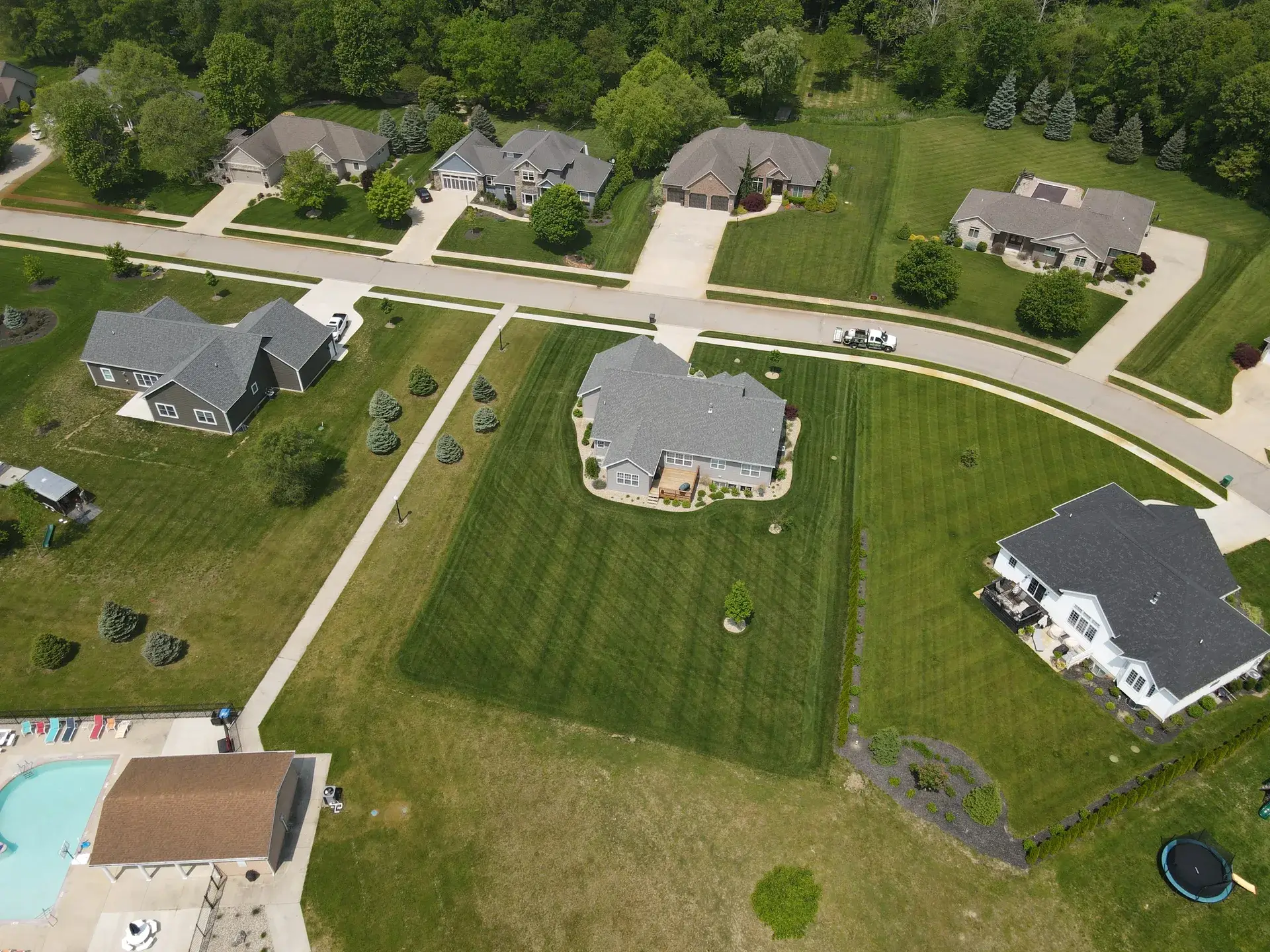
About 525 yards are already on our schedule, and every one of them started with a walk. You tell us what the lawn is doing wrong, we tell you what is going on underneath it, and we quote a program that matches. Small lot in town or a few acres out on a county road, the approach is the same.
What your lawn does across a northern Indiana year
Knowing what is coming is the difference between a lawn you are patient with and a mid-July phone call asking what went wrong.
April
April is a lie. The first warm week fools people. The grass greens up and everyone wants a feeding, but the soil is still cold and the roots have not started pushing. Anything heavy that goes down early either runs off in the spring rain or drives top growth the roots cannot support. The one thing that has to happen in April is the pre-emergent, and it has to be down before the soil at the top couple of inches holds steady in the mid 50s.
Late May
Late May is the truth. The real growing season starts once nights are consistently in the 50s and the soil has warmed. This is when a healthy lawn takes off, when weed control does its best work on actively growing broadleaf, and when the color you were expecting in April finally shows up.
July
July is survival, not failure. Cool-season turf, meaning Kentucky bluegrass, perennial ryegrass and tall fescue, is not built to grow in 90 degree heat. Color pulls back, growth slows, and a healthy lawn tans out in its driest spots while it waits the heat out. Watering deeply once or twice a week beats a daily sprinkle, and mowing a notch higher shades the crown. July is also when grub eggs have hatched, so preventive work belongs early to mid month and curative work lands August into September.
September
September is when the real work happens. Local rainfall drops from about 4.88 inches in June to 2.91 inches in September, roughly a 40 percent decline, exactly when the turf is recovering and fall seed needs steady moisture. Once daytime highs leave the 90s we put down the most valuable feeding of the year. Core aeration and overseeding go in now rather than in spring, because new seed gets cool nights, warm soil and no crabgrass competition. A yard that gets September right looks different by Halloween.
November
November decides next spring. The last feeding is a quiet one, put down near or after the last mow while the lawn is still green. The plant is not growing on top anymore, but the roots are, and they store what we feed them. Skip it and you spend April trying to force color that a November visit would have given you.
What actually goes wrong on a home lawn here
Five failure modes cover almost everything we get called about, and you can spot most of them from your own porch.
Thin shade
Grass under a mature maple is competing with the tree for water, light and root space, and it is losing. You get thin turf, moss creeping in, and bare patches that stay bare no matter how much seed goes down. We overseed with a shade-tolerant mix and adjust what the area is expected to hold. Where the canopy is dense we will tell you plainly that some spots are not going to carry grass.
Compaction on newer lots
If the house was built in the last fifteen years, chances are the topsoil was scraped off, the subsoil was driven on by heavy equipment, and a thin skin of black dirt was rolled over the top. Roots hit that pan and stop. You see runoff after every rain, footprints that stay for hours, and a lawn that browns before your neighbor's does. Core aeration in fall, two or three years running, is the thing that actually opens the ground back up.
Grubs
Beetle eggs have hatched by the end of July and the larvae feed on roots through August into September. You often will not know it is grubs until a section of turf lifts like a rug because the roots underneath are gone. If you have had them once you will have them again, and prevention in early to mid July costs a fraction of the repair. There is a short guide to spotting the damage early if you want to check before we do.
Summer disease
Hot humid stretches with heavy dew set up brown patch and dollar spot. Round or irregular tan patches show up almost overnight, often in the same low areas year after year. More water is not the answer, this is a fungus and watering usually makes it worse. A timed fungicide program protects the lawn through the risky window instead of chasing damage afterward.
Fed for years, never tested
A lawn can be over-fertilized and still hungry if the pH is off or a nutrient is locked out. This is the yard where bag after bag has gone down and the color still is not right. A soil test tells us what it actually needs. Indiana restricts phosphorus on established lawns, and we run phosphorus-free unless a soil test says otherwise. There is more in why soil fertility beats a quick-fix bag of fertilizer.
How it works
What a first season with us looks like
-
We look at the lawn first
Before we quote anything, we walk the property and read what the turf and the soil are actually telling us. Thin shade, compacted ground, an old grub problem, and a fungus all look like brown grass from the porch. They need four different fixes. We check where water sits after a storm, where the mower has been scalping, and whether the ground under a bad spot feels like concrete or like a sponge. That walk is the piece a phone-only quote cannot cover.
-
You get a program built for your yard
The program is written for your property, not for a truck route. A half-acre in full sun near Winona Lake and a shaded lot in Columbia City don't need the same year, and your quote reflects that. If the yard is mostly healthy you'll see a lighter plan. If it's been fed for years but never aerated, we'll say so and put aeration in the fall instead of piling on more fertilizer.
-
Visits are scheduled, not guessed at
Applications land in the window they belong in. Pre-emergent goes down before soil temperatures let crabgrass germinate. Grub control goes down ahead of the hatch. You know a technician is coming before he shows up. The windows here are short. September is the most valuable feeding of the year, and a lawn that misses it goes into winter thinner than it should.
-
You can reach a local person
Call (574) 549-3650 about a spot in the back yard and you'll talk to somebody in Pierceton who has walked yards like yours. No ticket queue, no call center reading a script. If you're not sure whether a brown patch is dormancy or disease, ask. Telling the difference over the phone is most of what we do in August.
What a lawn program costs, and what moves the price
We do not publish prices, because no two yards cost the same and a company that quotes you before seeing the property is guessing. What we can do is tell you exactly what moves the number, so the quote is readable when it lands.
- Treated turf square footage, not lot size
-
We price the grass we actually apply to, not the deed acreage. A one-acre lot with a big house, a pool, three landscape beds and a wooded back half can have less treated turf than a half-acre lot that is all open lawn.
- How many applications the program carries
-
Standard, Advanced and Preferred each run a different number of visits and a different level of feeding and weed work. The program you pick moves the price more than any other single factor.
- Access and obstacles
-
A wide-open front yard takes less time than a fenced back yard with a swing set, a bed weaving through the middle and a steep grade along one side. Every gate, bed edge, slope and play structure adds handling, and anywhere a spreader cannot safely go gets done by hand.
- Fall add-ons
-
Aeration and overseeding are not part of a standard fertilization program. They are the two services that make the biggest difference on a tired, thin or compacted lawn, and they are priced on top.
- Pest add-ons
-
Mosquito control, flea and tick, and perimeter work around the house each carry their own schedule and their own line.
Give us the address on the quote form and we will walk it and give you a real number rather than a range.
Kids, pets, and the day of a treatment
Before we come
Pick up dog toys, tennis balls and water bowls before the visit, and the same for kid toys and lawn chairs sitting out on the grass. The technician needs a clear surface to apply to, and anything left behind catches product it should not.
While we're there
You will know we have been by. Yard flags go in along the treated areas so the lawn is marked, and they stay until you pull them.
If a back-yard gate is locked and we cannot get in, we treat what we can reach and leave a note. Call us and we will get the back yard picked up on another day. It happens, and we work around it.
After we leave
Some applications need water to move them into the soil and others need to dry undisturbed. Which one applies depends on what went down and on the weather that day, so the specifics live on the note rather than in a blanket rule here. Read the note before you turn the kids or the dog loose on the lawn. It says what was applied, which areas, and what to do next.
Scheduling around your life
What we need from you
You do not need to be home. Most applications happen while people are at work. What we need is lawn access, which on a fenced yard means an unlocked gate on the day of the visit, and we let you know before we come so it is not a surprise.
If you use a mowing company, keep them. We do not mow, and we work around whatever schedule they run. It is usually easier when their day and our day are not the same, but if they overlap we would rather go after the mow than before, so the treatment is not cut off before it settles.
What we handle
Weather reschedules happen. If rain is an hour out we do not put down something that needs a day to dry, and if the wind is up we do not spray. We would rather move a date than waste a treatment.
When the visit is done the technician leaves a note. If a question comes up after we have gone, call (574) 549-3650 and you will get a local person in Pierceton rather than a call center.
What we don't do
That focus is deliberate. Lawn health, soil fertility, weed control, and insect and pest work around the outside of the house is the whole business, and it is what we have been doing here for over ten years.
That does not mean we leave you to figure the rest out. If you need someone to cut the grass or do landscape work, ask us and we will point you to a company we trust. We would rather hand you a name than have you guess, and we would rather do one thing properly than add a service we would be average at.
If you need someone to cut the grass every week or install a paver patio, we are the wrong call and we will say so. Keep your mowing company, hire a landscaper for the hardscape, and let us handle what is happening in the soil, in the turf, and around the perimeter of the house.
Fertilization programs
Three levels of feeding and weed control
Fertilization and weed control is where most residential accounts start. It comes in three levels, and the right one depends on the yard.
- Standard is our program for non-irrigated lawns. Season-long feeding, crabgrass prevention, grassy weed control, and spring and fall broadleaf weed control, kept budget-friendly.
- Advanced is for irrigated properties. Higher feed rates, fall nitrogen boosters, and preventative grub control, delivered with fewer emissions and less plastic.
- Preferred puts a licensed technician on your property every five weeks with fertilizer and weed control on every visit, plus insect protection and season-long lawn-health diagnostics.
Every service, in one place
All nine are on the table for a residential yard. Most homeowners start with fertilization and weed control, then add whatever the yard turns out to need.
Lawn care
Around the house
Homeowners around the lakes keep us on the schedule year after year. Rated 4.9 out of 5 across 50+ Google reviews. Read the reviews
Questions
What homeowners ask before signing up
Do you mow lawns?
No. We're a lawn-health and exterior pest-control company. We fertilize, control weeds, aerate, overseed, dethatch, treat disease and insects, and handle pests around the outside of the house. Keep your mowing company. We work around them.
How often does someone come out?
Depends on the program. Standard and Advanced fertilization run on a seasonal schedule. Preferred puts a licensed technician on your property every five weeks across the growing season, seven visits in all. Aeration, overseeding, and pest services are booked on top of whichever one you pick.
Do I need to be home when the tech comes?
No. Most applications happen while people are at work. We just need lawn access and any back-yard gates unlocked. The technician leaves a note about what was put down and anything you need to do next.
Is it safe for kids and pets?
Yes, once the application is dry or watered in, depending on the product. Your technician tells you the exact wait time for what he put down that day, and it's on the note he leaves behind.
Do you treat lawns outside Warsaw?
Yes. We're in yards across Kosciusko, Whitley, southwest Allen and Huntington counties, from Winona Lake, Pierceton, Leesburg, Syracuse, and North Webster on the lake side to Columbia City, Larwill, South Whitley, Milford, Roanoke, and southwest Fort Wayne, including the Aboite area.
How long before the lawn looks better?
It depends on what's wrong. Weeds knock down within a couple of weeks. Color and thickness follow the feedings and usually show inside a season. Rebuilding a thin or newly sodded lawn is longer, three to four full seasons of aeration, overseeding and consistent feeding before the turf outcompetes weeds on its own.
What moves the price on a lawn program?
Treated turf square footage rather than lot size, how many applications the program carries, how much handling the property needs around fences, slopes, beds and play equipment, and whether fall aeration and overseeding or any pest service comes along. We quote after we walk it, because quoting before you have seen a yard is guessing.
Why does my lawn look worse in July than it did in May?
Because July is survival, not failure. Cool-season grass is not built to grow in 90-degree heat, so it slows down, pulls back color, and tans out in the driest spots while it waits the heat out. Mow a notch higher, water deeply once or twice a week rather than a little every night, and it comes back when the weather does.
Tell us what your lawn is doing
We'll walk the property, tell you what's actually going on, and put a price on fixing it. About 525 yards are already on our schedule.