

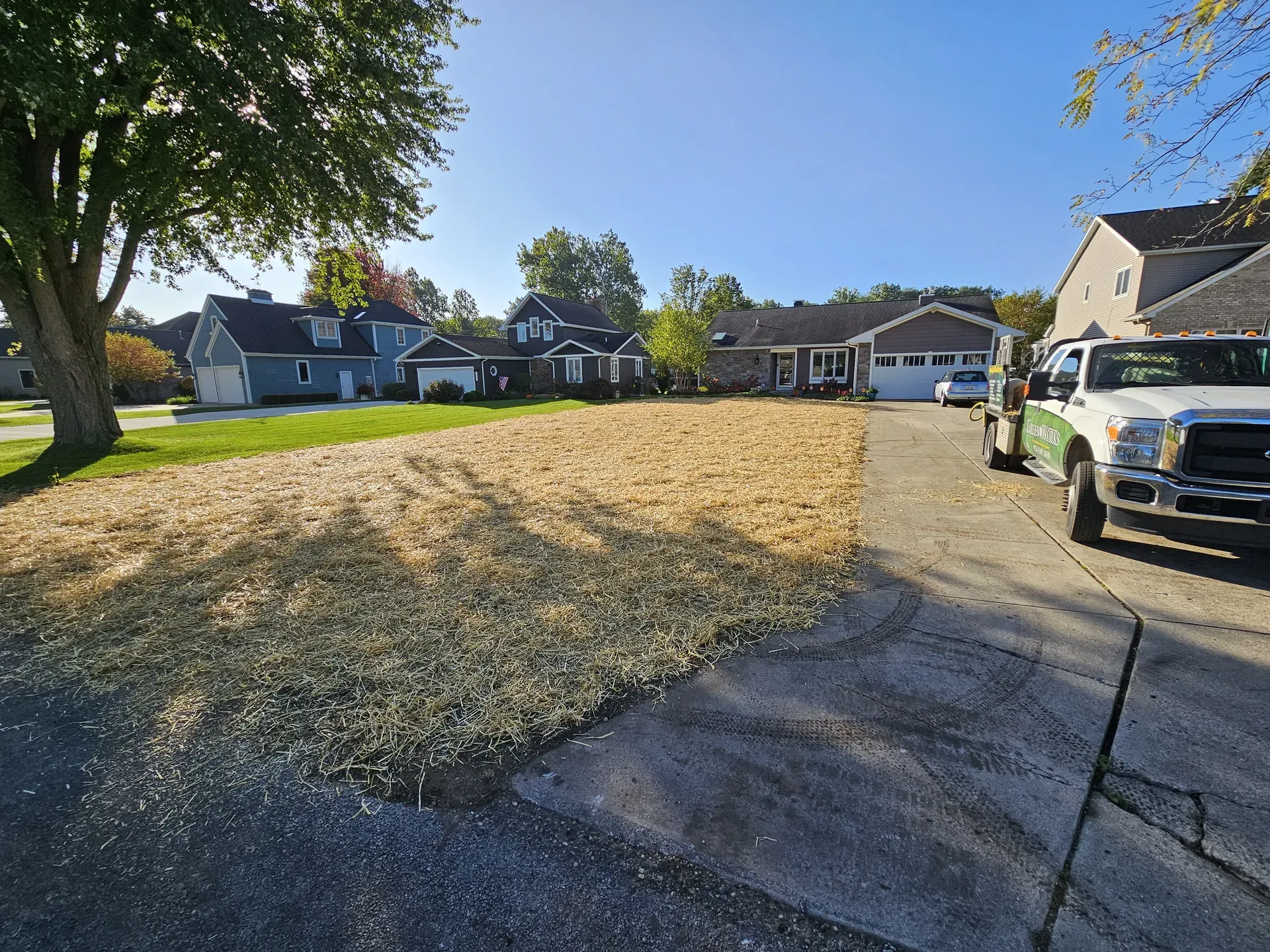
Grubs feed on turf roots from late July into September. The first sign is usually an irregular brown patch that stays brown no matter how much you water it, and turf that peels back like loose carpet because the roots underneath are gone. By the time most homeowners call about that patch, the feeding has been going on for six weeks. Catching it earlier is mostly a matter of knowing what week to start looking, and doing the check at the edge of the damage rather than the dead center.
The insects behind the damage
Three species cause almost all of the grub damage we see across Kosciusko, Whitley, southwest Allen and Huntington counties. Japanese beetle, masked chafer (the annual white grub), and occasionally May or June beetle.
The first two share the same calendar. Adults fly in late June and July and lay eggs in turf, favoring lawns that are sunny and moist, which in practice means irrigated lawns. Eggs hatch in about two weeks. The grubs that come out are small and feed on fine roots close to the surface.
They stay small through most of August. Then they size up, and their appetite sizes up with them, which is why a lawn can look fine on the first of September and look terrible by the twentieth.
What the damage actually looks like
Grub damage has a signature. It shows up as irregular, spreading patches rather than the neat circles or rings you get from most turf diseases. The turf in the patch takes on a grey-green cast first, then goes brown.
Watering doesn’t bring it back. That’s the tell that separates grubs from drought stress. Drought hits the high spots and the edges by the driveway first, and it greens back up within a few days of a real rain.
Damaged turf feels spongy underfoot. Push at the edge of a patch with your shoe and it moves, because the roots holding it down have been chewed off.
The animals often notice first
Plenty of people find out they have grubs when something else digs up the lawn. Skunks and raccoons work overnight and leave the turf flipped over in ragged strips. Crows and starlings punch small holes across an area in the morning.
Animals digging in a lawn in late summer is a signal, not a coincidence. They’re after a food source that’s worth the effort, and grubs at full size are exactly that.
How to check your own lawn
Pick a spot at the edge of a damaged area, not the dead center. Grubs move away from turf they’ve already killed, so the center of a dead patch often comes up empty and tells you nothing.
Cut a one-foot square about two to three inches deep on three sides with a spade, then peel the flap back like a page. Count what you find. Grubs are cream colored, curled into a C, with a brown head and three pairs of legs near the front.
A healthy lawn tolerates a few. Five or fewer per square foot is background noise on turf with a decent root system. Eight to ten per square foot is the range where visible damage starts, and anything past that will thin the lawn out.
Check three or four spots across the yard. Grubs are patchy by nature, and one sample isn’t a survey.
Where we see the pressure
Irrigated lawns in full sun draw more egg laying than dry, shaded ones, because beetles are looking for moist soil their eggs can survive in. The newer subdivisions on the west side of Warsaw, the flat sunny yards around Winona Lake, and the well-tended lots in Pierceton with a working irrigation system are all in that category. Add mature plantings that Japanese beetles feed on, roses, lindens, birch, and grapes among them, and adult pressure through July climbs.
History is the best predictor. A lawn that had grubs two years ago sits in the same neighborhood, next to the same egg-laying adults, and it will likely see them again.
Why prevention works and rescue treatments often don’t
Preventative grub control goes down before or right around egg hatch. The active ingredient sits in the root zone so newly hatched grubs take in a lethal dose while they’re still tiny and easy to kill. Applied on time, that approach is dependable.
Curative treatments are a different proposition. They target grubs that are already large, already feeding hard, and already sitting deeper in the soil. Control is less consistent, it takes heavy watering to move the product down to them, and even when it works the roots are already gone. You’ve stopped the feeding, not repaired the lawn.
Preventative grub control is included in our Advanced Program and our Preferred Program for that reason. It costs less trouble than fixing the aftermath, and the timing is the whole game.
Repairing what the grubs took
Turf with its roots destroyed doesn’t recover. It has to be reseeded. Fall works in your favor here, since the best seeding window in northern Indiana lands right after the damage becomes visible.
Core aeration and overseeding in the same visit is the usual fix. Keep the seedbed lightly moist rather than soaked, and expect four to six weeks before the area looks like lawn again.
What we see on the route
A common call runs like this: mid-September, a homeowner in a Warsaw subdivision with an irrigation clock waters harder for a week because the yard is going off, and by the time we get there the turf lifts in his hand. The crows already told him something was wrong three days earlier and he didn’t put it together. A quick square in the wrong spot, dead center, came up empty and he was ready to blame the water. One square at the green edge found nine grubs and settled it. The rescue treatment cleaned up the count, but the seeding was the actual fix, and next year that yard will start with a preventative application before the beetles ever lay.
What to do about it
If you’re seeing patches that won’t green up, or animals digging where they never used to, it’s worth having someone put a spade in the ground before you replace the whole lawn. Request a Free Quote and we’ll check the count, tell you what’s actually going on, and lay out the timing for grub control next year so this one doesn’t repeat.
Related services
- Grub Control Kills grubs at the root
More lawn care tips
- Why soil fertility beats a quick-fix bag of fertilizer August 21, 2026
- When to core aerate your lawn in northern Indiana August 21, 2026
What we do about it
- Grub Control Kills grubs at the root