
Whitley County, Indiana
Lawn care and pest control in Columbia City
We treat lawns across Columbia City out of the Pierceton shop, straight down US 30. Fertilization, weed and grub control, core aeration and overseeding, and exterior pest work around the house, on one program written for the clay till that most of the town sits on.
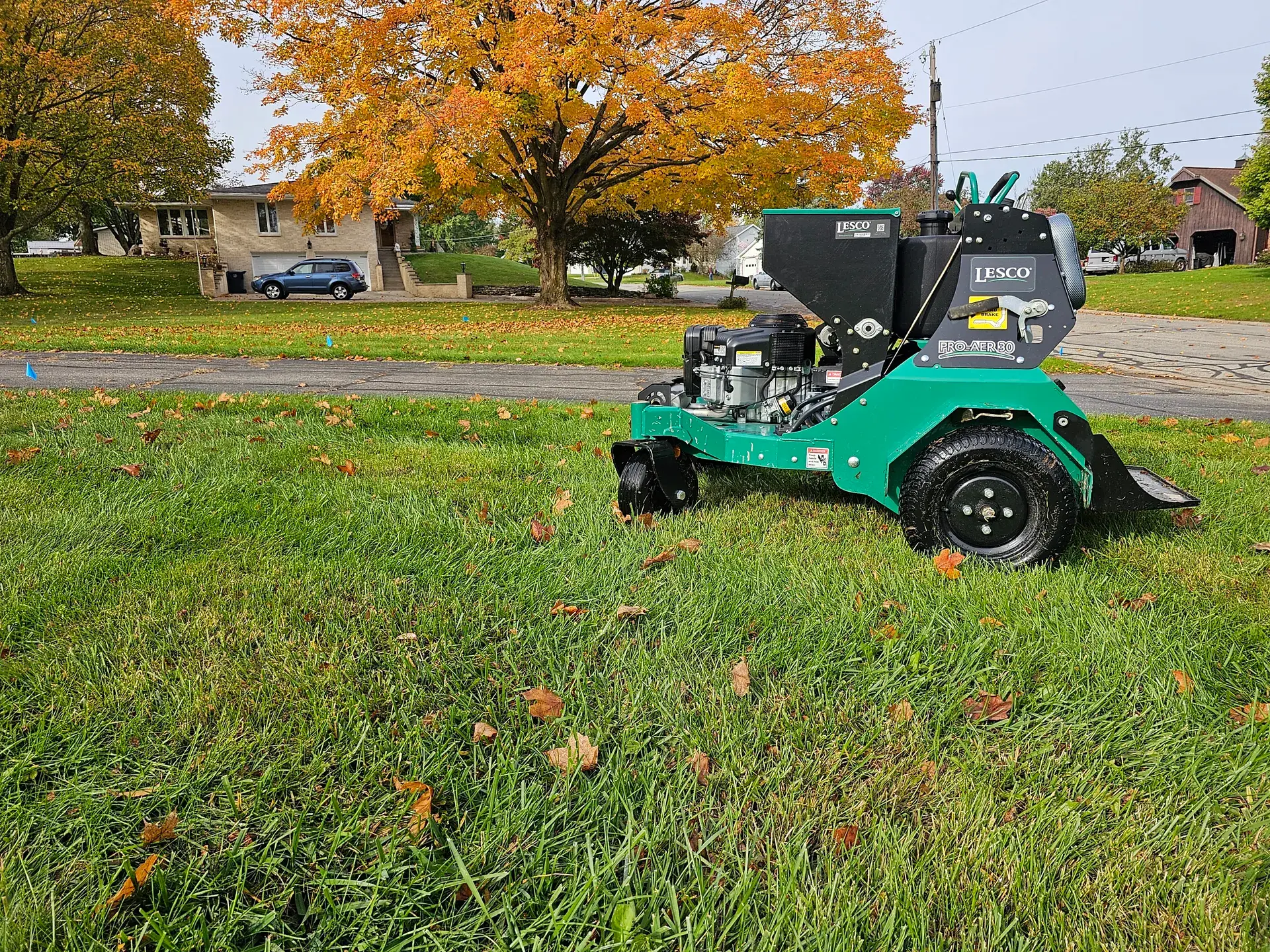
Eight inches down, the ground changes
Columbia City is a clay-till town. About half of the city sits on Blount, Glynwood and Morley loams, laid down on interlobate moraine, and another nine percent is Pewamo silty clay loam in the low ground, which the USDA rates as very poorly drained and hydric. If your yard holds water into May and dries into a cracked crust by August, that is the ground telling you what it is.
The topsoil is not the trouble. The first eight inches passes water at a reasonable clip and carries about a quarter clay, which is enough to feed a lawn well. Then the profile changes. The layer starting at eight inches carries around forty percent clay and passes water at roughly a tenth of the rate the topsoil does. That is a tenfold drop, from a horizon roots want to be in to a horizon they cannot get through. Three feet down there is a densic layer that roots do not enter at all.
On much of the town's dominant ground the seasonal water table sits about nine inches below the surface from November through May. That is a perched water table, water stopped by the layer it cannot move through, and it is the reason so many Columbia City lawns feel spongy in the spring, thin out in July, and never quite recover in the fall. Rain has no downward exit until the profile drains sideways or evaporates.
That is the plain-language case for aeration over another round of fertilizer, and it is a measurement rather than an opinion. Pulling cores opens that eight-inch boundary so water, air and nutrients get past it, and roots have somewhere to go. Fertilizer dropped on ground that will not breathe is money sitting on top of a lid.
The Morley on the steeper slopes off the moraine has its own trouble. Where it has eroded, the surface is already clay loam rather than loam, and its topsoil passes water at about a third of what an uneroded Morley does. Those are the yards that shed a summer storm across the drive instead of taking it in.
- County
- Whitley County
- ZIP codes
- 46725
- From the shop
- East of the shop, the county seat one county over.
- Ground
- Clay till. The top eight inches are a decent loam, and right underneath sits a subsoil better than forty percent clay that water barely moves through.
- Drainage
- Nearly stops eight inches down. Under the largest soil in the city a water table sits about nine inches deep from November through May.
- Housing
- Median home built around 1985, but the town is two towns: about a fifth predates 1939 and better than a third went up between 1990 and 2009.
What Columbia City properties need
What Columbia City lawns need
Every lawn gets a customized program. On this ground, the order these come in is not an accident.
-
Core Aeration
Eight inches down, Columbia City's clay till stops passing water at anything close to the rate the topsoil does. Pulling cores in fall breaks that boundary so rain, air and roots have somewhere to go, and every other service on this list works better once the profile can breathe.
See how it works -
Overseeding
Fresh bluegrass, rye and fescue seed dropped into open aeration holes in fall gets soil contact right where the profile is loosest. On heavy till, surface broadcasts sit on top and dry out. September rainfall runs under three inches here, so a new seeding still wants water put on it while it roots in.
See how it works -
Fertilization & Weed Control
Columbia City lawns can hold nutrients well when the top layer is breathing. We run phosphorus-free unless a soil test says otherwise, feed through the season instead of all at once, and time the pre-emergent to soil temperature rather than the calendar so crabgrass does not get its start along the warm curb edges.
See how it works -
Grub Control
Grubs work through August, and turf that is already stressed by a perched water table has less to give when the roots start disappearing. A preventative application in early summer stops them cheap. Repairing a chewed patch on clay in September, when rainfall drops, is slow work.
See how it works -
Perimeter Pest Control
More than a fifth of Columbia City's housing was built in 1939 or earlier, and older foundations give ants, spiders, boxelder bugs and stink bugs a lot of ways in around sills, vents and basement windows. A treated band around the outside of the house is what keeps them out of the kitchen.
See how it works -
Mosquito Control
The city drops larvicide briquettes into catch basins and retention ponds in warm weather, and that helps the public water. It does nothing for the adult mosquitoes resting in your shrub line, along the fence or under the deck. That shaded harborage on your own property is what a treatment here is aimed at.
See how it works
A county seat that takes its own yard rules seriously
Columbia City runs its own yard programs, and once you look at them together they add up to a city that pays attention.
The grass and rank vegetation limit is tighter than Warsaw's nine inches, at eight. A well-fed, dense lawn on a normal mowing week never gets close to that, but a vacant lot or a property between tenants can trip it fast. If you are getting notices, the fix is turf healthy enough to compete rather than a bigger mower.
Leaf pickup is loose rather than bagged, which is worth knowing if you have moved here from a town that bags. Rake to the curb in the fall, and in early spring the city turns those leaves into free mulch and hands it out on a first come basis. It is a small thing and it is a good one, because it puts organic matter back into ground that is not overrun with it. Limb and brush pickup runs one week a month, April through October, out by seven on the Monday of pickup week.
The best of the bunch is the mosquito program. The city puts larvicide briquettes into catch basins and retention ponds through spring and summer, and, unusually, sells the same briquettes to residents at the Utility Office for a dollar each. What it will not do, and what any honest program cannot claim, is touch the adult mosquitoes resting in a homeowner's own shrub line at dusk. A briquette in a catch basin two blocks away has nothing to say about the back yard, which is what a treatment on the property is for.
Columbia City lawn questions we get
Why does my lawn feel spongy in April and dry out hard in August?
That is the perched water table doing both jobs on the same yard. Water gets into the top eight inches of clay till and then hits a layer it cannot move through, so it sits until the ground can shed it sideways or evaporate. Once the surface finally dries in summer, the roots have nowhere deep to draw from and the lawn thins. Aeration is what breaks that pattern.
My back yard is the low spot on the block. Anything help?
Some of Columbia City sits on Pewamo, a silty clay loam the USDA rates as very poorly drained and hydric. On ground like that, aeration and overseeding with a heavier fescue mix will get you further than another round of feed. If a real drainage fix is needed, we will say so rather than sell you treatments that cannot win.
Do you use phosphorus on lawns here?
Not by default. Columbia City is the upstream end of the Upper and Middle Eel River watershed, and the watershed plan approved by IDEM and the EPA in January 2024 found phosphorus above the target in almost every sample pulled from that reach. Indiana restricts phosphorus on established lawns, and we run phosphorus-free unless a soil test says otherwise.
Does the city's mosquito program cover my yard?
It covers public catch basins and retention ponds with a larvicide briquette, which is genuinely useful for keeping breeding down on public water. It does not treat private yards, and it cannot reach the shaded resting spots where adult mosquitoes spend the day. That is what a treatment on your own property is for.
What is the grass ordinance here?
Columbia City's limit is tighter than Warsaw's nine inches, at eight. A lawn that is fed, dense and controlled for weeds should not come close in a normal week. If you keep getting notices, the answer is a stand of turf strong enough to hold pace with the mowing schedule.
Do you mow lawns in Columbia City?
No. We are a lawn-health and exterior pest-control company. We feed the soil, control weeds and insects, treat around the outside of the house, and aerate and overseed. Someone else cuts the grass. If you need that someone, ask us and we will point you to a company we trust.
Nearby
Nearby towns we also treat
Larwill, South Whitley, Pierceton and Roanoke are all on the same Whitley County run, and most weeks we are in one of them.
Get a price on your Columbia City lawn
Send the address and what is bothering you about the yard. We will walk it, tell you whether it is the clay eight inches down, the low corner that never drains, or something simpler, and put a program and a price in front of you.