

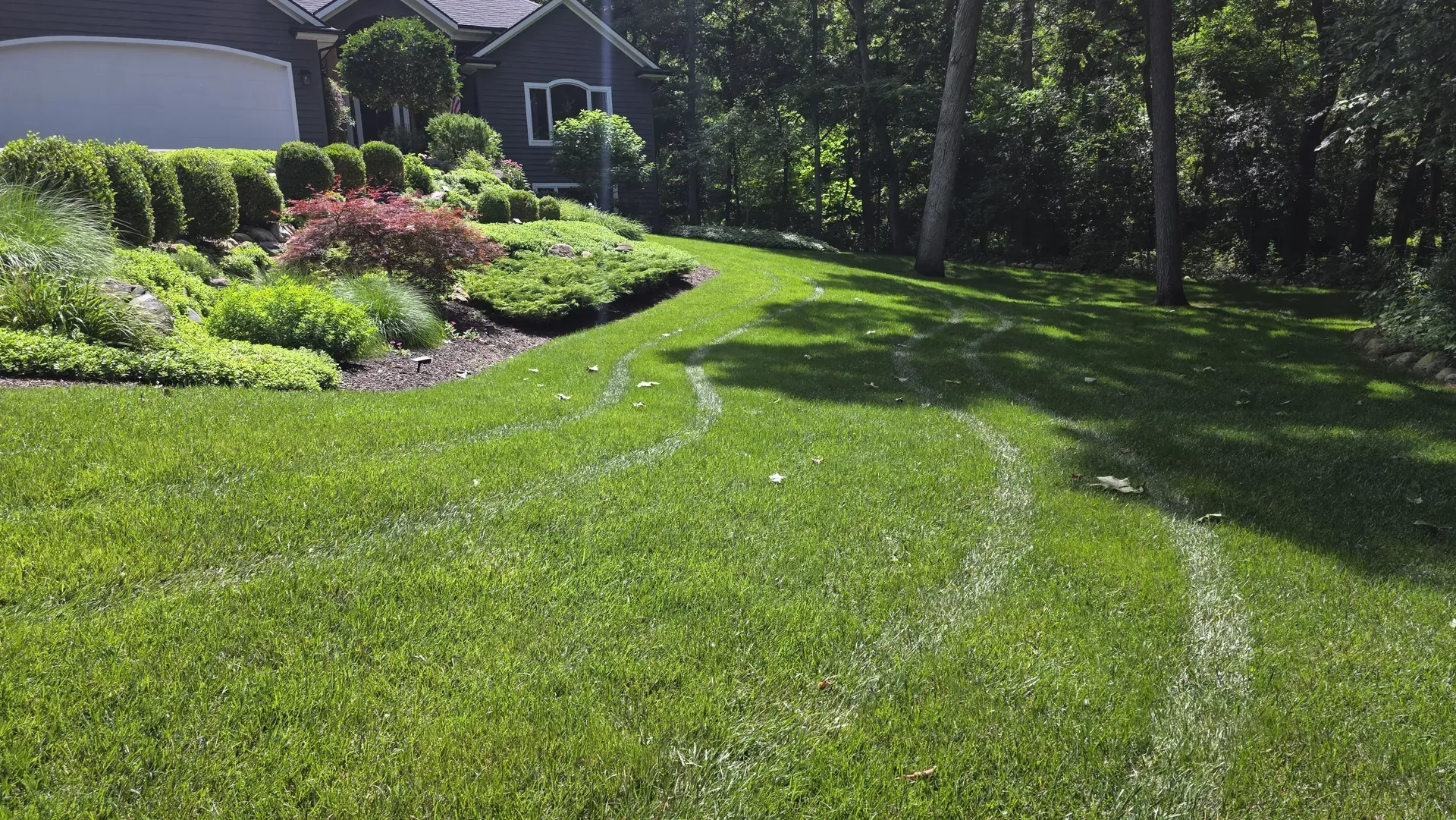
Ticks don’t live on an open, mowed lawn. They live in the transition between mowed turf and everything unmowed behind it, along fence lines and woodlines, in tall grass, in leaf litter, and in shaded groundcover. They arrive on deer, small mammals, and ground-feeding birds, then wait at the edge for the next warm body to walk by. Understanding where they are is half of controlling them. Spraying open lawn accomplishes almost nothing. Treating the edge, and keeping that edge cut back, is what quiets a property.
Where ticks actually live
A tick’s whole day is spent trying not to dry out. Open turf in the sun kills them within hours, which is why healthy mowed lawns aren’t a habitat.
The habitat is the shady, humid layer under leaf litter, at the base of tall grass, in ivy and pachysandra beds, in unmaintained fence rows, and in the first ten to twenty feet of woods that borders a yard. They climb a blade of grass or a low twig, hold on with their back legs, and wait with their front legs out for something to walk by. That behavior is called questing, and it happens right at the edge.
A property in Pierceton with mowed lawn out to a woodline has a tick problem concentrated in a strip you can measure with a tape. Same for a lot in Larwill whose back fence runs into brush, or a lake yard in North Webster where the mowed grass gives way to shaded shoreline groundcover. The rest of the yard, the sunlit turf out in the middle, is safer than most people think.
How they get moved onto your property
Ticks are terrible at moving under their own power. A blacklegged tick that never got a ride would spend its life within a few yards of where it hatched.
The rides do the work. White-tailed deer carry adult ticks and drop them everywhere they graze, which is most yards across the route at some point overnight. White-footed mice and chipmunks carry the smaller nymphs into stone walls, woodpiles, and shrub beds. Ground-feeding birds move them across neighborhoods.
That’s why a well-manicured yard in the middle of a subdivision still has ticks. The neighbor’s overgrown fence line, the woodlot two streets over, the deer that walked through at 3 a.m., all of it feeds the edge of your property.
The blacklegged tick and Lyme in Indiana
The blacklegged tick, sometimes called the deer tick, is present in most Indiana counties, and it’s the only tick in Indiana that transmits Lyme disease. Purdue Extension has tracked its spread across the state for years, and blacklegged ticks are well established in northern Indiana counties, ours included.
American dog ticks and lone star ticks show up here too, and they bite people, but the Lyme concern is the blacklegged tick specifically. Nymphs are active in late spring and early summer, they’re the size of a poppy seed, and they’re the reason people get bitten without ever noticing the tick.
We’re not going to give medical advice on this page. What we will say is the population is real, it’s established here, and reducing exposure at the property line is worth doing.
What actually reduces ticks in a yard
Edge treatment is the meaningful work. Our flea and tick program treats the first several feet on the yard side of every woodline, fence, and shrub bed, plus known harborage like ivy patches, stone walls, and woodpiles. Open turf gets almost nothing, because open turf has almost nothing on it.
Treatments run on a rotation through the active season. One pass isn’t the season, the same way it isn’t for mosquitoes. Ticks come in from adjacent property continuously, and the residual on treated surfaces breaks down over a matter of weeks.
Applied to the right places at the right time, the drop in tick encounters on a treated yard is fast and noticeable. Applied to the wrong places, it doesn’t much matter what’s in the tank.
Keep the transition zone honest
Where the mowed lawn meets the unmowed area is the most important line on the property, and most yards let it blur. A three-foot band of tall grass along the back fence is prime tick habitat, and it’s doing more to hold ticks than any woodlot fifty feet behind it.
The practical steps are unglamorous. Mow tight to the fence and the treeline. Cut back the ivy and the pachysandra where they’ve crept out from the beds. Rake leaves out of the transition zone in the fall so a wet layer isn’t sitting there all winter. If you have a swing set or a play area, put it in the sun, away from the woods and away from the mulch beds, and put a wood chip or gravel band between it and any planted edge.
Deer control is the other piece and it’s harder. Fewer deer through the yard means fewer adult ticks dropped. Fencing, plantings deer won’t touch, and simply not feeding them all help at the margins.
We don’t mow and we don’t landscape, so the edge maintenance is on the homeowner or on whoever cuts the grass. It’s worth telling that person to hold the mower tight to the line.
What to do after time outdoors
Do a tick check after any time in tall grass, woods, or shaded beds, on yourself and on the kids. Nymphs are tiny and they favor warm hidden spots, the back of the knee, the waistband, the hairline, the armpit.
If you find one attached, pull it straight out with fine tweezers as close to the skin as you can. Don’t twist, don’t burn it, don’t smother it in petroleum jelly. Any tick you’re unsure about is worth saving in a sealed bag and showing to a doctor if a rash or symptoms develop. Beyond that we’ll stay out of the medical lane.
Wash the clothes you were wearing in hot water and run them through a hot dryer. The dryer heat is what kills ticks that came home on fabric, not the wash.
What we see on the route
A common one: a homeowner off Old 30 near Columbia City is finding ticks on the dog every evening in June, treats the whole yard himself with a hose-end product, and gets nothing. The dog was cutting through the same six-foot strip of tall grass along the back fence every trip out. Once the strip got mowed tight, the fenceline got treated, and we set the rotation, the dog stopped bringing them in within two visits. Nothing about the middle of the yard changed. The line at the edge was doing the work.
What to do about it
If ticks are keeping the kids or the dog out of the back yard, Request a Free Quote and we’ll walk the property, look at the edges and the harborage, and put a flea and tick rotation together that fits what’s actually happening on your line. Your vet handles the on-animal preventative for the dog, and the two work together.
Related services
- Flea & Tick Control Safer grass for kids and pets
More pest control tips
- When mosquito treatment starts in northern Indiana September 15, 2026
- Why ants show up in the kitchen in September September 15, 2026
What we do about it
- Flea & Tick Control Safer grass for kids and pets