

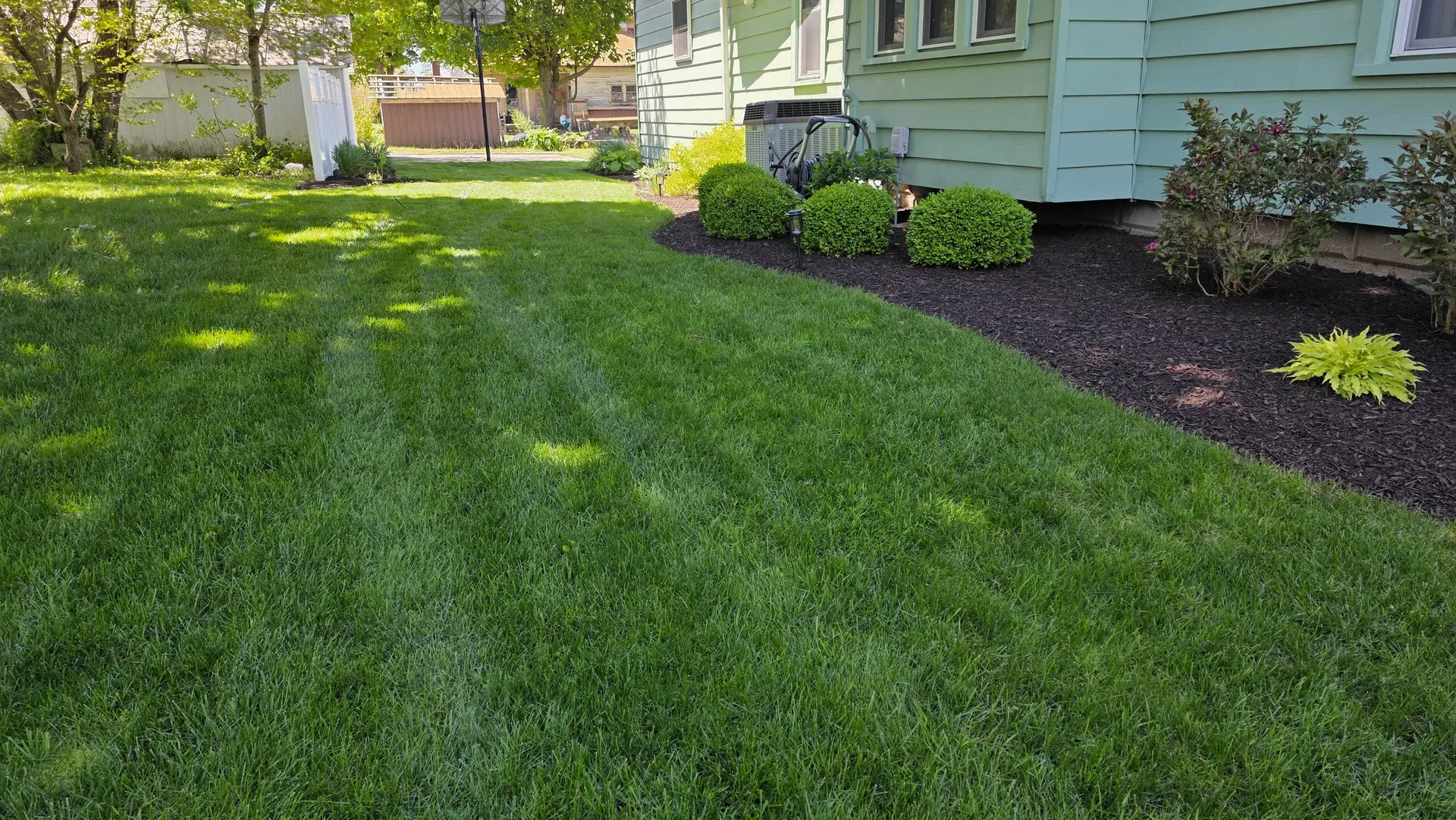
Ants and spiders show up in the kitchen in September because northern Indiana nights start cooling well before the frost, and both are looking for a warm, stable place to overwinter or ride out a cold snap. They come in through the same seams and gaps they’ve used all summer. You just notice them now. The fix isn’t spraying baseboards inside. It’s a treated band on the outside of the foundation that intercepts them before they cross the threshold. That’s what our perimeter pest control is built to do.
What changes in September
First frost around here typically lands mid to late October, but the cooling starts weeks before. Once overnight lows drop into the fifties, insects that spent the summer outdoors start looking for cover during the day and staying under it longer at night.
Ants that lived in the mulch bed all summer are suddenly reading the temperature gradient at your foundation. The masonry holds heat from the day. The seam where the siding meets the sill plate is warmer than the yard. They follow the gradient, and if there’s an opening at the end of it, they’re on the counter.
Spiders follow the ants and the other insects they eat. They’re opportunists, and a house that lets in a lot of small prey is a house that will have spiders.
Where they actually get in
Most homeowners look at doors and windows. Those matter, but they’re usually not the main entry.
The main entries are lower on the wall and around the mechanical guts of the house. The seam where the siding meets the foundation. The gap around a utility penetration, a hose bib, an electrical service, an AC line set, a dryer vent, a gas line. The threshold under an exterior door where the sweep has flattened. Weep holes in a brick veneer. Crawlspace vents. Basement window wells that fill with leaves.
Every one of those is a highway. A single ant scout that finds food inside will lay a trail back through the same gap, and by the next morning you have a line of them across the countertop.
Why an exterior treated band is the thing that works
A perimeter treatment is a band around the base of the house, extending a few feet out into the mulch and lawn and up the foundation as far as the material sensibly goes. The point isn’t to kill ants indoors after they arrive. The point is to make the outside of the wall a place they won’t cross.
Anything that walks through that band picks up enough material to die before it reaches the interior. Trails collapse. Scouts that go looking don’t come back to recruit the colony.
Inside sprays do the opposite of what people expect. They kill the ants you can see, which is a small fraction of the colony, and they do nothing about the pressure on the outside of the wall. The pressure is where the work belongs.
Our program treats the exterior band on a rotation, hitting the foundation, the utility penetrations, the door thresholds, the weep holes, and the harborage in the mulch and along the walk. Interior work isn’t what we do. GreenWorks is an exterior pest company by design, and it’s the more effective end of the problem anyway.
Older housing stock gives more ways in
An older home gives ants, spiders, and boxelder bugs more ways in. Framing has moved with a hundred winters, sills have gaps under them, the original penetrations have been redone twice, and the caulk around the last remodel is fifteen years old.
The route carries a lot of that housing. In Pierceton, where we’re based, nearly half the homes were built before 1939 and the median year built is 1944. Larwill is close to the same, with roughly the same share of pre-1939 stock and a median in the mid-1940s. Leesburg sits in the same range, with more than four in ten homes predating 1939 and very little new construction since. Warsaw’s older neighborhoods and downtown South Whitley both carry a similar character where the older streets sit.
A 1930s frame house on a stone foundation is going to have more entry points than a house built in 2015, and the perimeter treatment on it has to work harder as a result. That’s not a knock on the houses. It’s the reality of what a treatment is up against, and it’s why the rotation matters more on older homes than on newer ones.
What a homeowner can seal
You can do a lot with a tube of caulk and a Saturday afternoon. The goal is to close the easy entries so the treated band is doing less work.
Walk the outside of the house and look low. Any gap wider than a credit card around a utility penetration should be sealed, silicone or polyurethane sealant for masonry, expanding foam behind that for larger voids, then sealant over the foam. Replace door sweeps that have flattened. Screen crawlspace vents and dryer vents. Clean out basement window wells so leaves aren’t sitting against the glass.
Inside, look under sinks where the plumbing comes through the wall. That’s a common one people forget. Seal around the pipes with caulk or a rodent-rated foam.
Keep mulch pulled back a few inches from the foundation where you can. Mulch banked against the siding is warm damp harborage, and ants love it. Move firewood off the wall, ten feet away is better than two.
What we don’t do
To keep the expectations right: GreenWorks is an exterior pest company. We don’t do interior pest control, we don’t do termites, and we don’t do wildlife. If the issue is a colony inside a wall cavity, mice in the attic, or termite tubes on the foundation, we’ll tell you and point you to a company that handles it.
For the ants on the counter and the spiders in the corner of the ceiling, the exterior program is the answer, and it usually clears both within the first two treatments.
What we see on the route
The seasonal call is predictable enough that we build the fall rotation around it. Second week of September, the phone rings for ants on the counter at an old house on the north side of Warsaw. A walk of the outside finds a hose bib with a gap you could put a pencil into, a weep hole in the brick two feet off the ground, and a door sweep that stopped touching the threshold about three years ago. First treatment collapses the visible trail inside a few days. The second catches whatever came looking for the same gap after. From there the rotation holds it, and next fall the same house doesn’t call.
What to do about it
If the counter is getting scouted again or the basement corners are filling with webs, Request a Free Quote and we’ll walk the outside of the house, find the entries, and put a treated band on that keeps the season from becoming a running battle. Perimeter pest control is the exterior program built for exactly this: ants, spiders, and the other outside insects that would rather be inside your kitchen.
Related services
- Perimeter Pest Control Keeps bugs out of the house
More pest control tips
- How ticks get into a yard, and what actually keeps them out September 15, 2026
- When mosquito treatment starts in northern Indiana September 15, 2026
What we do about it
- Perimeter Pest Control Keeps bugs out of the house